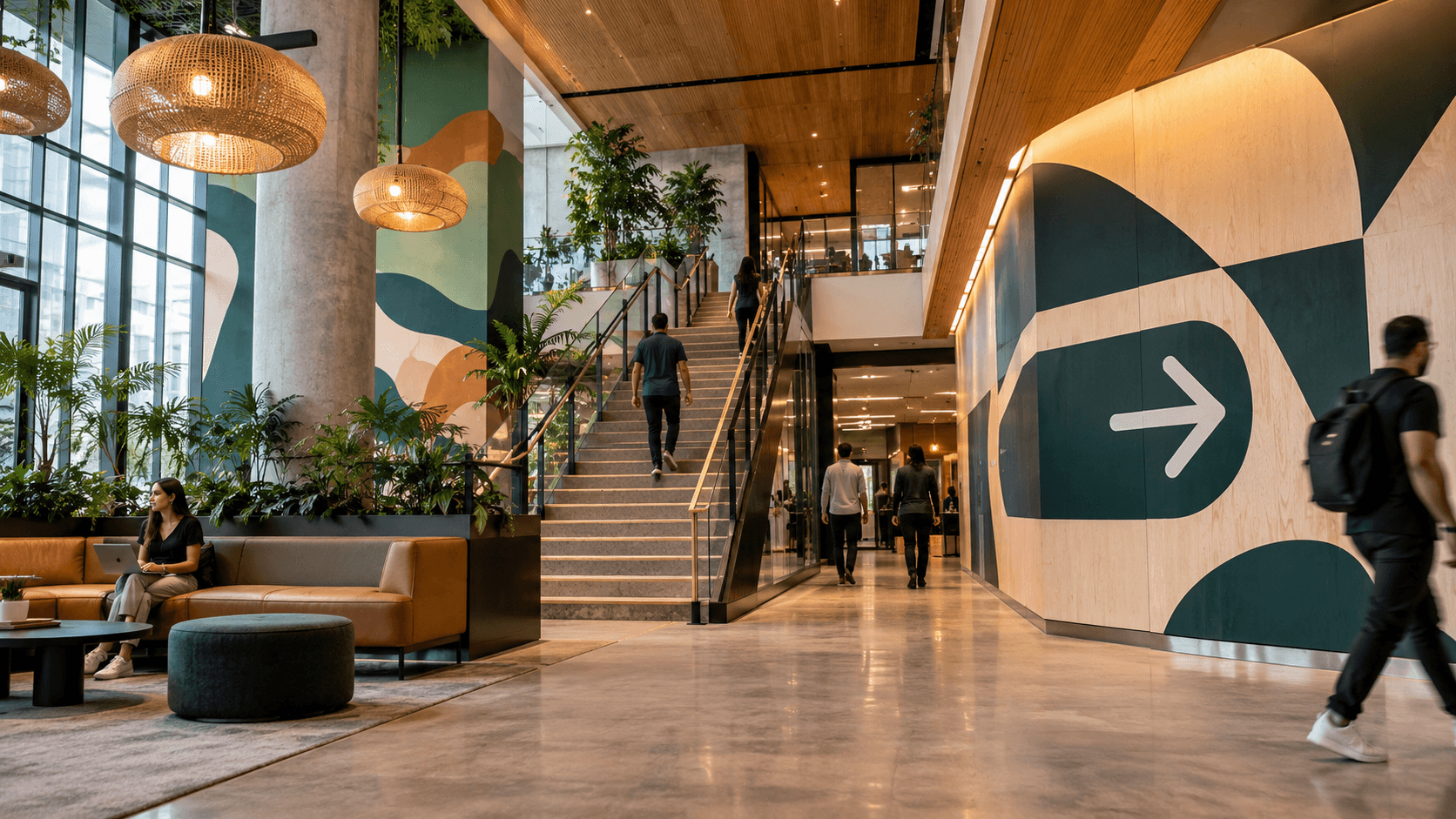
Good environmental graphic design is easy to underestimate because, when it works, people simply move through a space without thinking about the design decisions helping them. They find the entrance, understand where to go, recognize the brand, and feel that the environment makes sense.
Environmental graphic design, often shortened to EGD, combines visual communication with physical space. It brings graphic design into architecture, interiors, landscapes, exhibitions, workplaces, retail environments, campuses, hospitals, hotels, transportation systems, and public places.
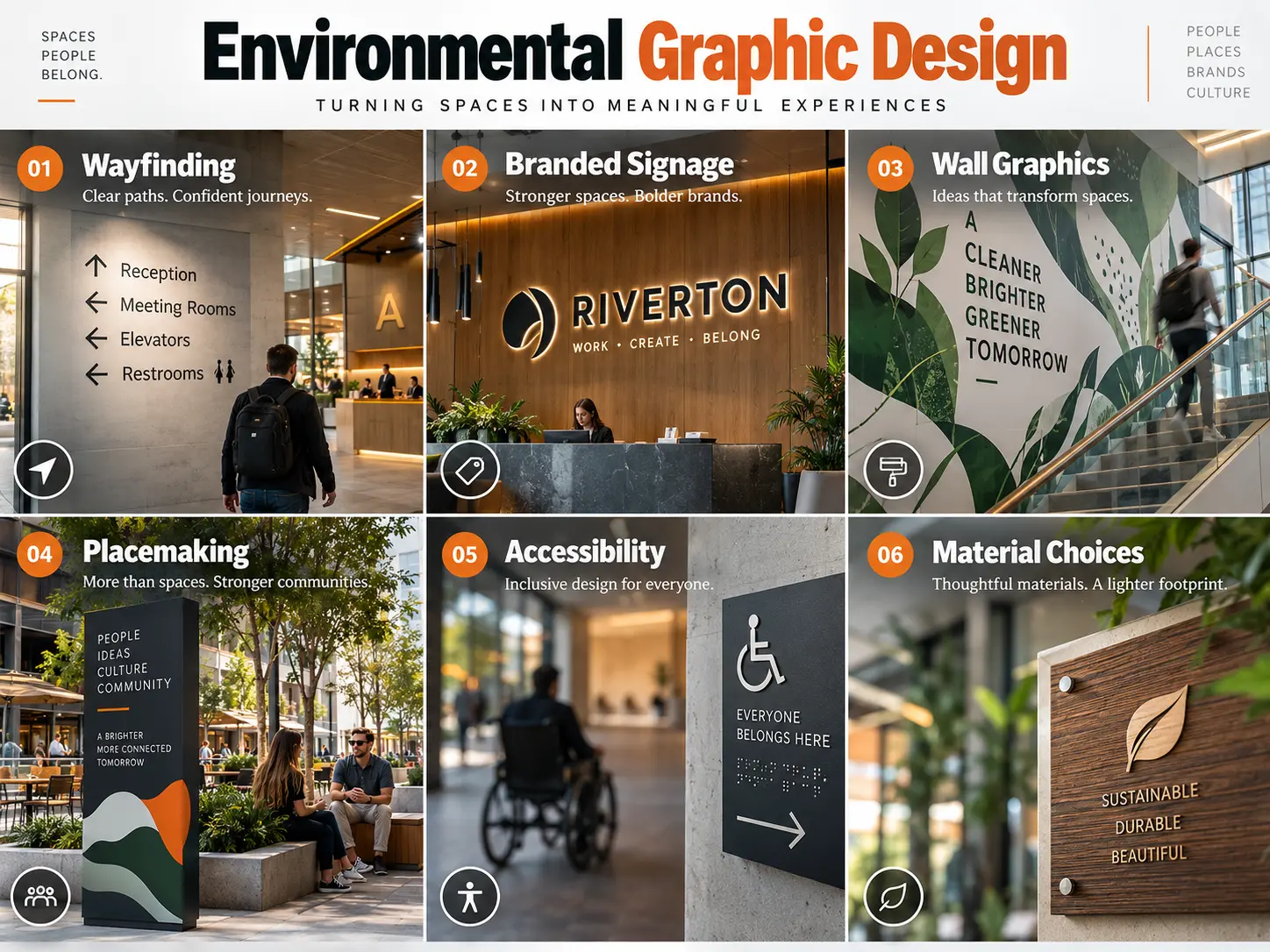
The field goes far beyond signs. It can include wayfinding, placemaking, branded environments, murals, supergraphics, interpretive displays, donor recognition, digital signage, exhibition graphics, and spatial storytelling.
For businesses thinking about how a brand should live beyond a screen, Axtronica Digital Studio treats environmental graphics as part of a broader identity system: typography, color, imagery, messaging, and visual hierarchy have to remain recognizable while also working at architectural scale.
Table of Contents
What Is Environmental Graphic Design?
Environmental graphic design is the design of visual communication within the built environment. Its purpose can be functional, emotional, informational, or all three at once.
A wayfinding sign helps a visitor find a destination. A branded wall can communicate company culture. A museum exhibit can explain a story. A retail graphic can organize departments. A mural can create a memorable sense of place.
EGD sits at the intersection of several disciplines:
- Graphic design
- Architecture
- Interior design
- Industrial design
- Signage
- User experience
- Branding
- Exhibition design
- Accessibility
- Fabrication and installation
Because the work exists in real space, designers have to think about distance, movement, lighting, materials, sightlines, human behavior, and building constraints in addition to traditional layout.
The Main Types of Environmental Graphic Design
Wayfinding and Signage
Wayfinding helps people understand where they are, where they need to go, and how to get there.
A complete system may include:
- Entry identification
- Directional signs
- Room identification
- Floor directories
- Maps
- Parking guidance
- Regulatory signs
- Accessibility signs
- Emergency information
The best wayfinding systems reduce decision-making effort. Users should not need to stop and decode complicated signage every few meters.
Branded Environments
Branded environments extend a visual identity into physical space. Offices, stores, hospitality venues, healthcare environments, schools, and showrooms can all use graphic elements to make the brand feel present and consistent.
Typical elements include:
- Logo applications
- Wall graphics
- Color zoning
- Brand messaging
- Custom typography
- Pattern systems
- Glass graphics
- Dimensional lettering
- Feature walls
The goal is not to place a logo on every surface. Strong branded environments translate brand personality into spatial experience.
Placemaking
Placemaking helps a location develop a recognizable identity. It may use art, typography, historical references, color, environmental storytelling, and landmark graphics to make a space feel distinctive.
This is especially useful for:
- Mixed-use developments
- Public spaces
- Campuses
- Entertainment districts
- Parks
- Hospitality destinations
- Residential communities
Exhibition and Interpretive Design
Museums, visitor centers, galleries, trade shows, cultural spaces, and branded exhibitions use environmental graphics to organize information and tell stories.
This work may combine:
- Timelines
- Maps
- Artifact labels
- Large-format graphics
- Photography
- Data visualization
- Interactive displays
- Digital media
- Narrative text
The challenge is maintaining clarity while visitors are moving rather than sitting down to read a document.
Digital Environmental Graphics
Screens and interactive systems are increasingly part of the physical environment. Digital directories, menu boards, interactive kiosks, dynamic displays, and large-format LED installations can update information in real time.
Digital does not replace good spatial planning. It should still follow clear hierarchy, readable typography, appropriate viewing distance, and accessible interaction patterns.
Environmental Graphic Design vs Signage
The terms overlap, but they are not identical.
| Signage | Environmental Graphic Design |
|---|---|
| Often focused on identification or direction | Covers navigation, brand, experience, and storytelling |
| Can be a single sign or set of signs | Usually considers the larger spatial system |
| Primarily informational | Can be informational, emotional, cultural, and experiential |
| May be specified late in a project | Works best when integrated earlier with architecture and interiors |
A sign can be part of environmental graphic design, but EGD looks at how all visual communication works together across the environment.
Why Environmental Graphic Design Matters
It Reduces Confusion
Clear wayfinding lowers the mental effort required to navigate unfamiliar places. This matters in airports, hospitals, campuses, parking facilities, offices, and large public buildings where people may already feel rushed or stressed.
It Strengthens Brand Recognition
A physical environment can communicate a brand more powerfully than a digital ad because people experience it at full scale. Consistent typography, color, messaging, materials, and spatial details create stronger recognition.
It Improves User Experience
Visitors judge a space partly by how easy it is to understand. A beautiful building can still feel frustrating if people cannot find entrances, elevators, rooms, restrooms, or exits.
It Creates a Sense of Place
Environmental graphics can connect people to local culture, history, mission, or community. That makes a space feel less generic.
Core Principles of Effective Environmental Graphic Design
Visual Hierarchy
Not every message deserves equal weight. Important directional information should be visible before secondary details.
Use size, contrast, position, color, and spacing to make the reading order obvious.
Legibility
A typeface that looks elegant on a laptop may fail on a sign viewed from a distance. Environmental typography must consider:
- Viewing distance
- Letter height
- Contrast
- Lighting
- Movement speed
- Background complexity
- Character clarity
Consistency
A wayfinding system should not change visual language from one floor to the next without a reason. Consistency helps users learn the system as they move through the environment.
Simplicity
Too much information slows people down. Good environmental graphics communicate only what a person needs at that decision point.
Context
Materials, colors, shapes, and scale should fit the architecture and audience. A children’s museum, luxury hotel, industrial facility, and medical center require different visual decisions.
Accessibility
Accessibility should be considered from the start, not added at the end. Depending on jurisdiction and project type, this can involve contrast, tactile elements, Braille, mounting heights, symbol use, readable typography, accessible routes, and compliance with applicable codes and standards.
Design teams should verify the current local requirements for the specific building and location.
Typography in Environmental Graphics
Typography is one of the most important tools in EGD because users often need to read while walking or driving.
A good environmental typeface usually has:
- Clear letterforms
- Strong distinction between similar characters
- Multiple weights
- Good spacing
- Strong legibility at distance
- A family broad enough for hierarchy
Decorative type can work for feature graphics, but critical directions should prioritize clarity.
Color and Contrast
Color can do more than make a space attractive. It can organize zones, distinguish floors, identify departments, reinforce brand identity, and draw attention to key information.
However, color should not be the only way information is communicated. Combine color with labels, icons, numbers, patterns, or other cues so the system remains understandable to more users.
Materials and Fabrication
A graphic designed for a screen has no weight, weather exposure, installation method, or maintenance requirement. Environmental graphics do.
Material decisions may involve:
- Painted surfaces
- Vinyl
- Acrylic
- Metal
- Wood
- Glass film
- Fabric
- Printed panels
- Dimensional lettering
- Illuminated signs
- Digital displays
The right material depends on indoor or outdoor use, expected lifespan, cleaning, vandal resistance, sunlight, moisture, mounting surface, fire requirements, budget, and brand expression.
The Environmental Graphic Design Process
1. Research the Space
Study floor plans, entrances, circulation, visitor types, decision points, architectural conditions, and existing signage.
2. Define User Journeys
Map how different people move through the environment. A first-time visitor has different needs from an employee who uses the building daily.
3. Build the Information Hierarchy
Decide what information appears at each point: identification, direction, confirmation, warning, interpretation, or brand messaging.
4. Develop the Visual System
Define typography, color, icons, imagery, layout, materials, and how the brand adapts to the environment.
5. Prototype and Test
Test sign size, placement, legibility, sightlines, and decision points. A design that works on a PDF may fail when installed several meters away.
6. Create Production Documentation
Prepare specifications for dimensions, materials, colors, mounting, fabrication, artwork, location schedules, and installation details.
7. Coordinate Fabrication and Installation
Design intent can be lost if fabrication is not coordinated carefully. Review samples, materials, finishes, scale, and placement before final installation.
8. Evaluate After Use
Observe how real people move through the space. If visitors regularly miss a turn or ask the same question, the system may need adjustment.
Common Environmental Graphic Design Mistakes
Designing Signs in Isolation
A collection of attractive individual signs can still create a confusing system. Plan the complete journey.
Using Too Much Text
People rarely want to read paragraphs while navigating. Edit aggressively and move detailed information to places where users can stop safely.
Prioritizing Style Over Legibility
Brand personality matters, but directional information has a job to do. Decorative typography should not compromise clarity.
Ignoring Architecture
Sign placement should respond to sightlines, doors, lighting, circulation, wall conditions, and structural limitations.
Considering Fabrication Too Late
Material thickness, mounting, seams, lighting, durability, and installation access can change the design. Involve production expertise early.
How Environmental Graphic Design Supports Branding
A strong brand identity should be flexible enough to work across a website, social media, packaging, print, signage, interiors, and physical experiences.
Our branding design services focus on building visual systems rather than isolated assets. That same system-thinking is valuable in environmental graphics because the logo, typography, color palette, imagery, and voice need to remain coherent at very different scales.
FAQs
Q1. What is environmental graphic design in simple terms?
It is the use of graphics, typography, signage, color, imagery, and information systems to help people understand, navigate, and experience physical spaces.
Q2. Is environmental graphic design the same as wayfinding?
No. Wayfinding is one important part of environmental graphic design. EGD also includes branded environments, placemaking, exhibitions, murals, interpretive graphics, and digital spatial experiences.
Q3. Where is environmental graphic design used?
It is used in offices, hospitals, schools, airports, hotels, retail stores, stadiums, museums, campuses, residential developments, public spaces, transportation systems, and many other built environments.
Q4. What skills does an environmental graphic designer need?
Useful skills include typography, layout, branding, color, information design, spatial thinking, user experience, signage systems, material knowledge, production documentation, and collaboration with architects, interior designers, fabricators, and clients.
Q5. Why is accessibility important in environmental graphic design?
People with different visual, mobility, cognitive, and sensory needs use the same spaces. Accessible design improves usability and may also be required by applicable building codes, accessibility standards, or regulations.
Design the Space as a Communication System
Environmental graphic design works best when graphics are treated as part of the environment rather than decoration added after the architecture is finished.
Wayfinding should reduce uncertainty. Branding should feel integrated. Typography should remain readable. Materials should suit the space. Accessibility should be considered early. And every element should contribute to a coherent experience.
When those pieces work together, the environment becomes easier to understand, more memorable, and more connected to the identity of the organization behind it.
Tagged with :