
An ecommerce SEO audit is different from a basic website audit because online stores create complexity at scale. Products change, inventory disappears, collections grow, filters generate URLs, apps add scripts, variants create duplicates, and merchandising decisions can affect how search engines crawl the entire catalog.
A good ecommerce SEO audit identifies which of those issues are limiting organic visibility and revenue. It should not simply report technical warnings. It should help the business decide what to fix first based on search demand, category importance, product value, and implementation effort.
At Axtronica Digital Studio, we recommend auditing ecommerce SEO across four connected layers: technical accessibility, site architecture, catalog content, and commercial performance.
Table of Contents
What Is an Ecommerce SEO Audit?
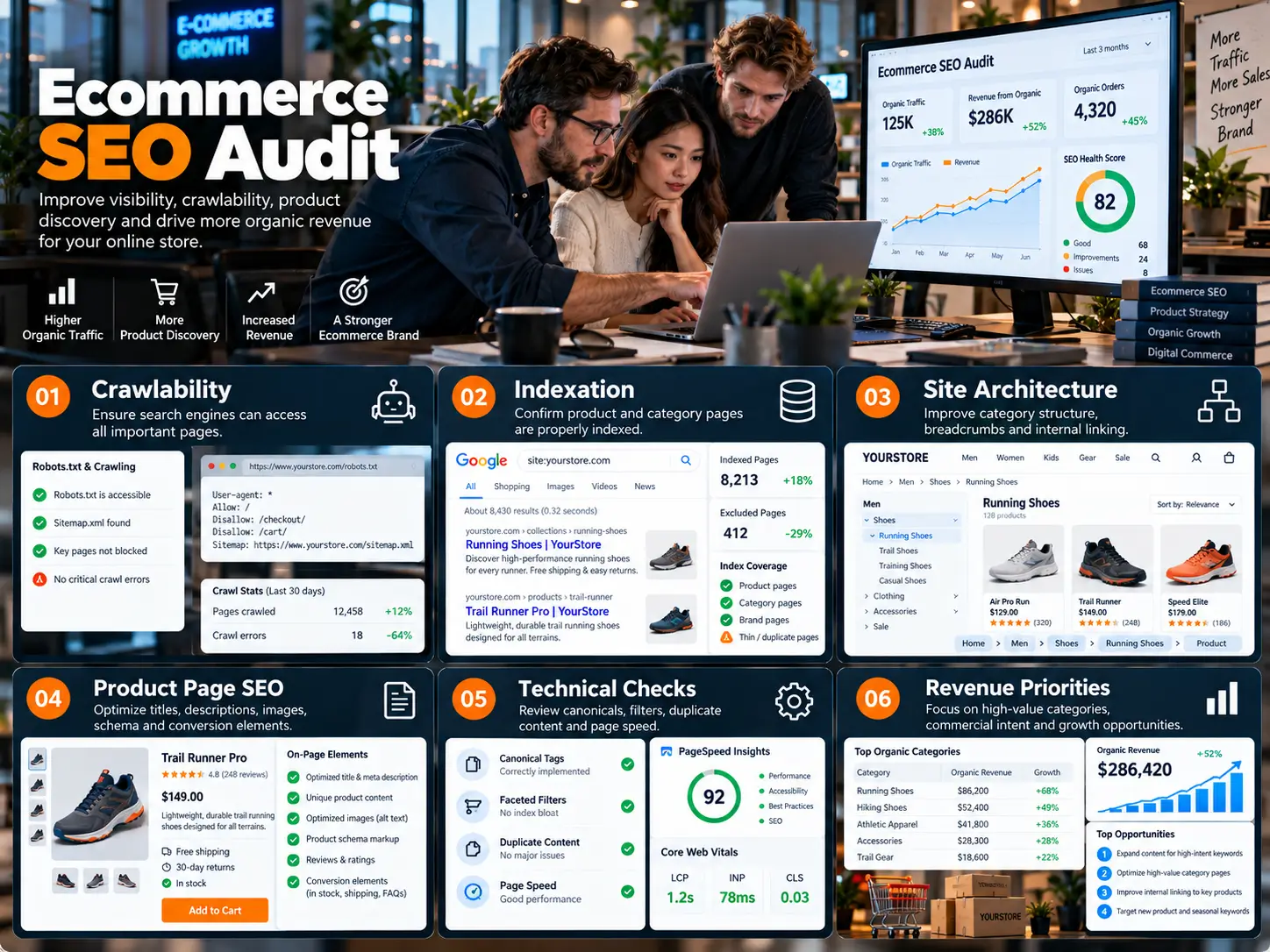
An ecommerce SEO audit is a structured review of an online store’s technical SEO, product and category content, site architecture, internal linking, structured data, authority, performance, and organic conversion paths.
It can uncover problems such as:
- Important products not indexed
- Duplicate variant URLs
- Weak collection pages
- Faceted navigation creating thousands of crawlable URLs
- Broken canonicals
- Slow product templates
- Thin manufacturer descriptions
- Orphan products
- Out-of-stock pages handled poorly
- Missing product structured data
- Broken internal links
- Search engines seeing different content from users
- Organic traffic landing on weak conversion pages
The larger the catalog, the more important prioritization becomes.
Start With Revenue and Category Priorities
Before crawling the store, identify what matters commercially.
Review:
- Highest-revenue categories
- Highest-margin products
- Strategic collections
- Seasonal categories
- Products with strong inventory depth
- Categories with organic growth potential
- Current organic revenue
- Paid search data that may reveal converting keywords
A technical issue affecting a major category deserves more attention than the same issue affecting a low-value archive page.
Crawlability and Indexation
The first question is whether search engines can discover and index the right URLs.
Review Robots.txt
Make sure important product, category, content, and asset URLs are not blocked accidentally. Also review whether low-value internal search or parameter areas need crawling controls.
Review XML Sitemaps
Sitemaps should contain canonical, indexable URLs that the business actually wants search engines to discover.
Check whether:
- Important products are included.
- Deleted or redirected URLs remain in the sitemap.
- Multiple sitemaps are organized logically.
- International versions are represented correctly.
Compare Published, Crawled, and Indexed URLs
A useful audit compares:
- URLs the platform publishes.
- URLs the crawler can discover.
- URLs search engines can render.
- URLs search engines actually index.
Gaps between those sets can reveal orphan products, blocked content, duplicate URLs, rendering problems, and weak internal linking.
Ecommerce Site Architecture
A clear hierarchy helps both shoppers and search engines.
A simple structure might look like:
Homepage -> Main Category -> Subcategory -> Product
Important categories should not be buried under many clicks or depend only on internal search.
Review:
- Main navigation
- Category hierarchy
- Breadcrumbs
- Related products
- Related categories
- Product-to-category links
- Blog-to-category links
- Orphan pages
Architecture should reflect how customers shop, not only how the internal inventory system is organized.
Audit Faceted Navigation and Filters
Filters are extremely useful for shoppers and one of the biggest sources of SEO duplication.
A store may create filter combinations for:
- Size
- Color
- Brand
- Material
- Price
- Style
- Availability
- Rating
- Features
If every combination creates a crawlable, indexable URL, the site can generate thousands or millions of low-value pages.
The right solution depends on the platform and whether specific filter combinations have real search demand. Some faceted pages may deserve to be indexable landing pages, while many others should be controlled through canonicals, noindex rules, crawl management, or architecture changes.
Do not block filters blindly without understanding how the site currently ranks.
Review Canonical Tags
Canonical tags help search engines understand preferred URLs when duplicate or similar pages exist.
Check:
- Product variants
- Tracking parameters
- Filter URLs
- Sort URLs
- Pagination
- Alternate paths to the same product
- HTTP/HTTPS and hostname consistency
A canonical should point to the page the business truly considers primary and that page should generally be indexable.
Product Page SEO Audit
Product pages should provide enough unique information to help both shoppers and search engines.
Review:
- Product title
- H1
- Description
- Specifications
- Images
- Alt text
- Reviews
- FAQs
- Shipping information
- Availability
- Price information
- Structured data
- Related products
- Internal links
Avoid copying the same manufacturer description across hundreds of stores when the product category is competitive. Add useful original details where the business can genuinely improve the buying experience.
Category and Collection Page Audit
Category pages often have greater SEO potential than individual product pages because they target broader commercial searches and remain stable as inventory changes.
A strong category page should include:
- Clear title and heading
- Useful introductory context
- Relevant products
- Helpful filters
- Internal links to subcategories
- Crawlable product links
- Supporting content where useful
- Descriptive metadata
- Fast performance
Do not bury products below an enormous block of SEO copy. Content should support shopping, not interfere with it.
Handle Out-of-Stock and Discontinued Products Carefully
Inventory changes can damage SEO when products are deleted without a plan.
Temporarily Out of Stock
If the product is expected to return, keeping the page live is often useful. Clearly show availability status and offer alternatives or notifications where possible.
Permanently Discontinued
If there is a close replacement, a 301 redirect may make sense. If there is no relevant replacement and the page has no ongoing value, a proper removal response may be more appropriate.
Avoid redirecting every discontinued product to the homepage.
Audit Product Structured Data
Structured data can help search engines understand product information.
Depending on the store and eligibility, product markup may include:
- Name
- Image
- Description
- SKU
- Brand
- Offers
- Price
- Currency
- Availability
- Reviews
- Aggregate rating
The markup should match visible page information. Do not add ratings or availability that users cannot see.
Audit Internal Linking
Ecommerce sites often rely too heavily on navigation and forget contextual links.
Look for opportunities to connect:
- Blog guides to relevant categories
- Buying guides to products
- Product pages to complementary products
- Categories to subcategories
- Seasonal hubs to collections
- Brand pages to relevant catalog areas
Use descriptive anchors that help users understand what they will find.
Audit Duplicate and Thin Content
Common ecommerce duplication includes:
- Product variants
- Manufacturer descriptions
- Category pages with little differentiation
- Filter URLs
- Sort parameters
- Internal search pages
- Print views
- Tracking parameters
Thin content does not always mean a page needs 1,000 words. A product page can be useful with concise copy if it provides accurate specifications, imagery, availability, reviews, and decision-support information.
Audit Page Speed and Core Web Vitals
Online stores often become slow because of:
- Large product images
- Review widgets
- Recommendation engines
- Tracking scripts
- Chat tools
- Apps and plugins
- Video
- Complex theme code
- Third-party personalization
Test several templates:
- Homepage
- Major category
- Product page
- Search page
- Cart
- Content page
Performance should be evaluated alongside functionality. Removing a script that drives important revenue may not be the right decision; optimizing how it loads may be better.
Audit JavaScript Rendering
Some ecommerce themes and headless implementations rely heavily on JavaScript.
Verify that search engines can access:
- Product names
- Descriptions
- Prices
- Availability
- Internal links
- Breadcrumbs
- Reviews where intended
- Structured data
Compare the initial HTML, rendered output, and what search tools report.
Review Mobile Shopping Experience
SEO traffic only has value if shoppers can use the site.
Check:
- Navigation
- Product images
- Variant selectors
- Filters
- Sticky add-to-cart behavior
- Readability
- Checkout entry
- Pop-ups
- Page speed
- Touch target size
A mobile page can be technically indexable and still convert poorly because the shopping experience is frustrating.
Audit Search Intent and Keyword Mapping
Map important keywords to the right type of page.
- Broad commercial terms often fit category pages.
- Specific model or product terms fit product pages.
- Comparison searches may fit buying guides.
- Problem-based searches may fit educational content.
Keyword cannibalization happens when several pages compete for the same intent. Consolidating or clarifying page purpose can strengthen relevance.
Audit Ecommerce Content Strategy
Useful ecommerce content should support purchase decisions and internal linking.
Examples include:
- Buying guides
- Size guides
- Comparison articles
- Product care guides
- Gift guides
- Compatibility guides
- Material guides
- How-to-use content
- Seasonal collections
The best topics connect naturally to products and categories rather than existing only to attract unrelated traffic.
Backlink and Authority Review
Evaluate which categories and products have earned links and where competitors have stronger authority.
Opportunities may come from:
- Digital PR
- Product reviews
- Partnerships
- Resource pages
- Original research
- Useful tools
- Industry publications
- Brand mentions
Avoid low-quality bulk link schemes. Ecommerce brands need relevant authority and real mentions.
Ecommerce SEO and AI Product Discovery
AI-powered search and shopping experiences place additional value on clear product data and strong brand information.
Make sure important details are consistent across:
- Product pages
- Structured data
- Merchant feeds where used
- Brand pages
- Category pages
- Reviews
- Policies
- Availability
Clear, crawlable product information helps both traditional search engines and newer discovery systems understand what the store sells.
Prioritize Ecommerce SEO Fixes by Revenue Impact
| Priority Factor | Question |
|---|---|
| Revenue importance | Does this affect a high-value category or product group? |
| Search opportunity | Is there meaningful demand? |
| Scale | How many URLs are affected? |
| Severity | Does the problem prevent crawling, indexing, or conversion? |
| Confidence | Do data and testing support the diagnosis? |
| Effort | How difficult is implementation? |
| Dependency | Must another fix happen first? |
This prevents teams from spending weeks on minor warnings while a major category remains blocked or poorly linked.
Ecommerce SEO Audit Checklist
Technical
- Crawl important templates
- Review robots.txt
- Validate XML sitemaps
- Check indexation
- Review canonicals
- Audit faceted navigation
- Test JavaScript rendering
- Check redirects and 404s
- Review page speed
- Validate structured data
On-Page and Catalog
- Map keywords to categories and products
- Review titles and headings
- Improve category content
- Improve important product content
- Check image alt text
- Review product reviews and FAQs
- Identify duplicate content
Architecture
- Review navigation
- Check breadcrumbs
- Find orphan products
- Improve internal links
- Review pagination and filters
Commercial
- Analyze organic revenue
- Compare mobile conversion
- Review high-value landing pages
- Check out-of-stock experience
- Prioritize by category value
When to Get Professional Ecommerce SEO Help
Professional support is especially useful when:
- The store has thousands of URLs.
- Organic traffic has dropped after a theme or platform change.
- Faceted navigation is difficult to control.
- Products are not being indexed correctly.
- A migration is planned.
- International storefronts are expanding.
- Development resources are limited.
- The team needs a prioritized implementation roadmap.
Axtronica Digital Studio provides ecommerce website services, while its SEO team can help connect technical SEO, category strategy, content, and site architecture into a unified growth plan.
FAQs
Q1. What is an ecommerce SEO audit?
It is a detailed review of an online store’s technical SEO, site architecture, products, categories, content, internal linking, structured data, performance, authority, and organic conversion opportunities.
Q2. How often should an ecommerce store run an SEO audit?
It depends on catalog size and how frequently the site changes. Large stores and fast-moving catalogs benefit from continuous monitoring plus deeper periodic audits, especially after platform, theme, app, navigation, or international changes.
Q3. What tools are useful for an ecommerce SEO audit?
Useful tools include Google Search Console, analytics, PageSpeed Insights, structured-data testing tools, a website crawler, and keyword or backlink platforms. Tool data still requires interpretation and prioritization.
Q4. Are product pages or category pages more important for SEO?
Both can be important. Category pages often target broader commercial terms, while product pages capture specific product and model intent. The right strategy depends on search demand and catalog structure.
Q5. Should out-of-stock product pages be deleted?
Not automatically. Temporarily unavailable products can often remain live. Permanently discontinued products should be handled based on whether a relevant replacement exists, whether the page has links or traffic, and whether it still provides value.
Turn the Audit Into a Revenue Roadmap
An ecommerce SEO audit should make a large store easier to understand and easier to improve. The goal is to ensure that search engines can access the right pages, shoppers can navigate the catalog, product information is clear, and the highest-value categories receive the strongest SEO support.
Do not fix issues simply because an audit tool labels them “errors.” Prioritize the problems that affect important products, categories, visibility, and revenue. Then validate the results after implementation and continue monitoring the store as inventory and technology change.
Tagged with :