
Ranking well in one country does not automatically mean a website will perform in another. Search behavior changes by market. So do language, terminology, competitors, buying expectations, regulations, currencies, shipping realities, and the way people phrase the same need.
That is why international SEO services should never be treated as a translation project. A serious international SEO strategy starts by deciding where demand actually exists, then builds the technical and content structure needed to serve the right page to the right audience.
At Axtronica Digital Studio, we recommend approaching international SEO market by market. It is better to build strong visibility in a priority country than to launch thin, poorly localized versions across ten markets at once.
Table of Contents
What Are International SEO Services?
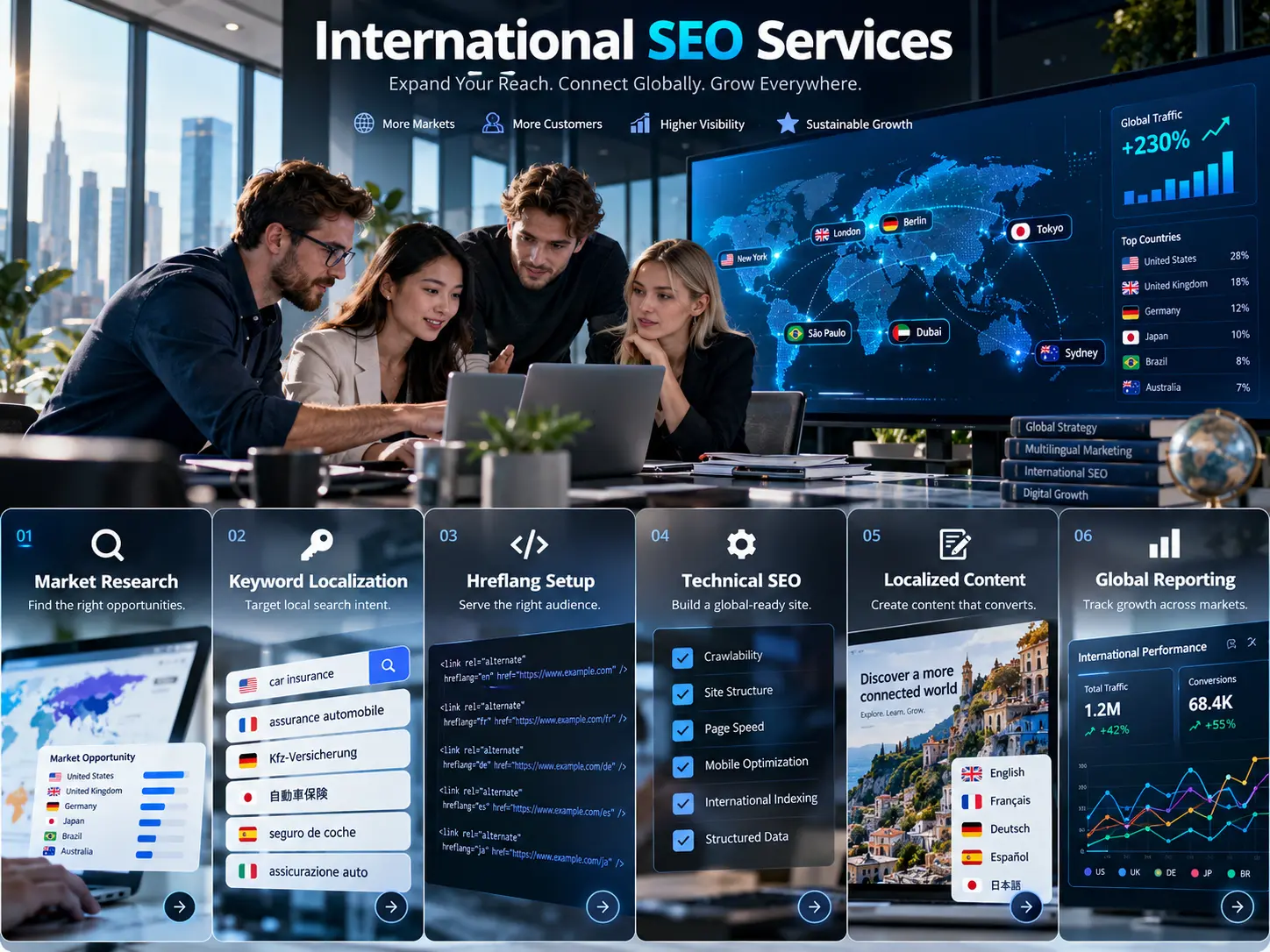
International SEO services help a website earn organic visibility across multiple countries, languages, or regional markets.
A complete program can include:
- International market research
- Country-specific keyword research
- Language and search-intent analysis
- International URL architecture
- Hreflang implementation
- Canonical and indexing management
- Localized content strategy
- Metadata localization
- Internal linking by market
- Regional competitor analysis
- Technical SEO
- Local authority and digital PR
- International analytics and reporting
- AI search visibility across languages and markets
The objective is simple: make it clear to users and search engines which content is intended for which market.
International SEO Is Not the Same as Translation
Translation converts words from one language into another. Localization adapts the experience for a specific market.
That distinction matters because people in different countries may use different terms for the same product or service. Even markets that share a language can have different spelling, terminology, expectations, regulations, and search intent.
For example, a phrase that performs well in the United States may not be the phrase people naturally search in the United Kingdom, Canada, Australia, or another English-speaking market.
A localized SEO strategy should research the market from the beginning instead of translating an existing keyword list and assuming the same intent carries over.
Start With Market Opportunity, Not Website Structure
Before deciding on subfolders, subdomains, or country-code domains, confirm that the target market is worth the investment.
Evaluate:
- Search demand
- Product or service fit
- Competition
- Existing customers or leads from the market
- Language requirements
- Shipping or fulfillment capability
- Sales coverage
- Local regulations
- Currency and payment needs
- Customer support capacity
- Conversion potential
SEO cannot compensate for a market the business is not operationally prepared to serve.
Choose the Right International URL Structure
There are three common approaches.
| Structure | Example | Strengths | Considerations |
|---|---|---|---|
| Country-code domain | example.fr | Strong country signal and local identity | Separate authority, cost, and maintenance |
| Subdomain | fr.example.com | Clear separation and flexible hosting | Can require more separate management |
| Subfolder | example.com/fr/ | Consolidates authority under one domain | Requires disciplined architecture |
There is no universal best structure. The choice depends on brand strategy, existing domains, technical resources, localization depth, and market needs.
A company should avoid repeatedly changing international architecture without a strong reason because migrations add risk.
Use Hreflang Correctly
Hreflang helps search engines understand language and regional alternatives of a page. It is useful when a site has similar content for different languages or countries.
Common implementation principles include:
- Use valid language and region codes.
- Make annotations reciprocal between corresponding pages.
- Reference canonical, indexable URLs.
- Keep hreflang aligned with the actual page language.
- Include a sensible x-default where appropriate.
- Avoid pointing users to irrelevant regional versions.
Hreflang does not create rankings by itself. It supports international targeting after the site has useful localized content and sound technical architecture.
Perform Keyword Research Separately for Each Market
International keyword research should be country-specific, not based on global search volume alone.
For each target market, research:
- Search volume in that country
- Local terminology
- Commercial intent
- Search-result format
- Competitors that rank locally
- Questions users ask
- Product or service modifiers
- Local brand preferences
- Seasonal differences
A direct translation may be grammatically correct and still fail because it is not what people actually search.
Localize Search Intent, Not Just Keywords
Imagine a company selling the same service in two countries. One market’s search results may favor service pages, while another may favor comparison guides or local directories.
That means the page format may need to change as well as the wording.
International SEO should ask:
- What does a searcher in this country expect to see?
- Which competitors dominate the results?
- Is the query informational, commercial, transactional, or local?
- Which proof points matter in this market?
- Does the page need local pricing, shipping, regulations, or case studies?
Search intent is local context expressed through a query.
Build Truly Localized Content
Strong localization can include:
- Native terminology
- Local spelling and grammar
- Local examples
- Currency
- Units of measurement
- Shipping information
- Contact options
- Regional product availability
- Local legal or compliance information
- Local case studies
- Market-specific FAQs
Machine translation can be a useful starting tool, but important commercial content should be reviewed for meaning, tone, cultural fit, and search intent.
Avoid Duplicate International Pages
Businesses sometimes create multiple country pages with nearly identical English content and only change the country name. That creates weak differentiation and may provide little value to users.
If several markets genuinely share the same language and offering, the solution may still involve similar content, but each version should exist for a real user reason and have a clear targeting strategy.
Do not create a new locale simply because it is technically easy.
Strengthen International Internal Linking
Users should be able to navigate between appropriate language or regional sections without getting trapped or redirected unexpectedly.
Internal links should also help search engines understand the hierarchy of each market.
Useful practices include:
- Keep navigation consistent within each locale.
- Link to localized equivalents where they exist.
- Avoid internal links that constantly send users back to the default country.
- Keep language switchers crawlable and understandable.
- Use descriptive anchors in the relevant language.
Technical SEO for International Websites
International sites can become technically complex quickly.
An audit should check:
- Crawlability
- Indexation
- Canonical tags
- Hreflang
- XML sitemaps
- Redirects
- Duplicate content
- JavaScript rendering
- Site speed
- Core Web Vitals
- Mobile usability
- Pagination
- Faceted navigation
- Parameter handling
- Locale switching
- Server and CDN behavior
The larger the number of markets and languages, the more important technical governance becomes.
Build Local Authority, Not Only Global Backlinks
A website may have strong authority in its home market but little recognition in a target country.
International authority building can include:
- Local industry publications
- Regional partnerships
- Local associations
- Digital PR
- Market-specific resources
- Relevant directories
- Local supplier or partner relationships
- Regional thought leadership
Quality matters more than collecting large numbers of low-value links.
Measure International SEO by Market
Do not combine all countries into one dashboard and assume the strategy is working.
Track each market separately.
| Metric | Why It Matters |
|---|---|
| Organic visibility by country | Shows market-specific search presence |
| Non-brand clicks | Indicates discovery beyond existing brand demand |
| Landing page performance | Reveals which localized pages attract traffic |
| Conversion rate by locale | Shows commercial effectiveness |
| Revenue or leads by market | Connects SEO to business value |
| Index coverage | Identifies technical gaps |
| Hreflang errors | Helps diagnose targeting problems |
| Local backlink growth | Measures regional authority development |
If one country is underperforming, the cause may be technical, competitive, linguistic, or commercial. Market-level reporting makes that easier to diagnose.
International SEO and AI Search
Users increasingly discover brands through AI-powered search experiences as well as traditional results. International content should therefore be clear, structured, and locally authoritative.
Helpful practices include:
- Clear company and product information
- Consistent brand entities
- Accurate regional information
- Strong service and product descriptions
- Helpful FAQs
- Original expertise
- Local evidence and citations where appropriate
- Structured data when relevant
The fundamentals are similar: make it easy for systems to understand who the company is, what it offers, and where each offer applies.
Common International SEO Mistakes
Translating the Existing Keyword List
Search behavior does not translate word for word. Perform fresh market research.
Using Hreflang as a Strategy
Hreflang is a technical annotation, not a substitute for useful localization.
Launching Too Many Markets at Once
Thin coverage across many countries can be harder to maintain than strong coverage in one or two priority markets.
Automatically Redirecting Users by IP
Aggressive redirects can create usability and crawling problems. Give users clear choices and preserve access to alternate versions.
Ignoring Local Conversion Factors
A page can rank and still fail if the currency, trust signals, shipping, contact methods, or offer do not fit the market.
When Should You Hire International SEO Services?
Specialist help becomes especially useful when:
- The website targets several countries or languages.
- Organic traffic is landing on the wrong regional pages.
- Hreflang errors are widespread.
- The business is planning a global migration.
- Content has been translated but does not rank.
- Regional teams are creating inconsistent pages.
- International ecommerce has complex product availability.
- Analytics cannot clearly separate markets.
- The company needs a repeatable framework for expansion.
Our SEO services can support market research, technical SEO, content structure, and international growth planning within a broader search strategy.
FAQs
Q1. What are international SEO services?
They are SEO services designed to improve organic visibility across multiple countries, languages, or regions. They typically combine market research, localized keyword strategy, technical architecture, hreflang, content localization, and regional reporting.
Q2. What is hreflang?
Hreflang is an HTML annotation that helps search engines understand the language and, where relevant, regional targeting of alternate versions of a page.
Q3. Do I need a separate domain for every country?
No. Country-code domains, subdomains, and subfolders can all work. The right choice depends on business strategy, technical resources, branding, authority, and localization requirements.
Q4. Can I use AI translation for international SEO?
AI translation can support workflows, but important commercial pages should be reviewed for accuracy, cultural fit, brand voice, search intent, and local terminology. Translation alone is not a complete international SEO strategy.
Q5. How long does international SEO take?
There is no fixed timeline. Results depend on competition, current authority, technical condition, localization quality, target markets, content depth, and implementation speed. International programs should be measured market by market over time.
Build One Global Brand With Local Search Relevance
International SEO services work best when global consistency and local relevance are balanced carefully. The brand should remain recognizable, but each market needs content, search targeting, and conversion details that feel natural to local users.
Start with market demand. Choose the architecture deliberately. Research keywords locally. Implement hreflang carefully. Localize the experience, not only the words. Then measure every market separately.
That approach creates a scalable international search foundation rather than a collection of translated pages competing for attention.
Tagged with :