
An SEO audit should do more than produce a long list of warnings. The real value is finding the issues that limit visibility, explaining why they matter, and turning them into a prioritized plan that a business can actually implement.
That is what professional SEO audit services are supposed to provide.
A website can lose search performance for many reasons: crawling problems, indexing mistakes, weak site architecture, outdated content, JavaScript rendering issues, poor internal linking, duplicate pages, broken migrations, slow performance, weak local signals, or simply stronger competitors. A good audit separates symptoms from causes.
At Axtronica Digital Studio, we recommend auditing SEO as a connected system. Technical health matters, but so do content quality, search intent, site structure, user experience, authority, conversions, and the way search engines and AI systems understand the brand.
Table of Contents
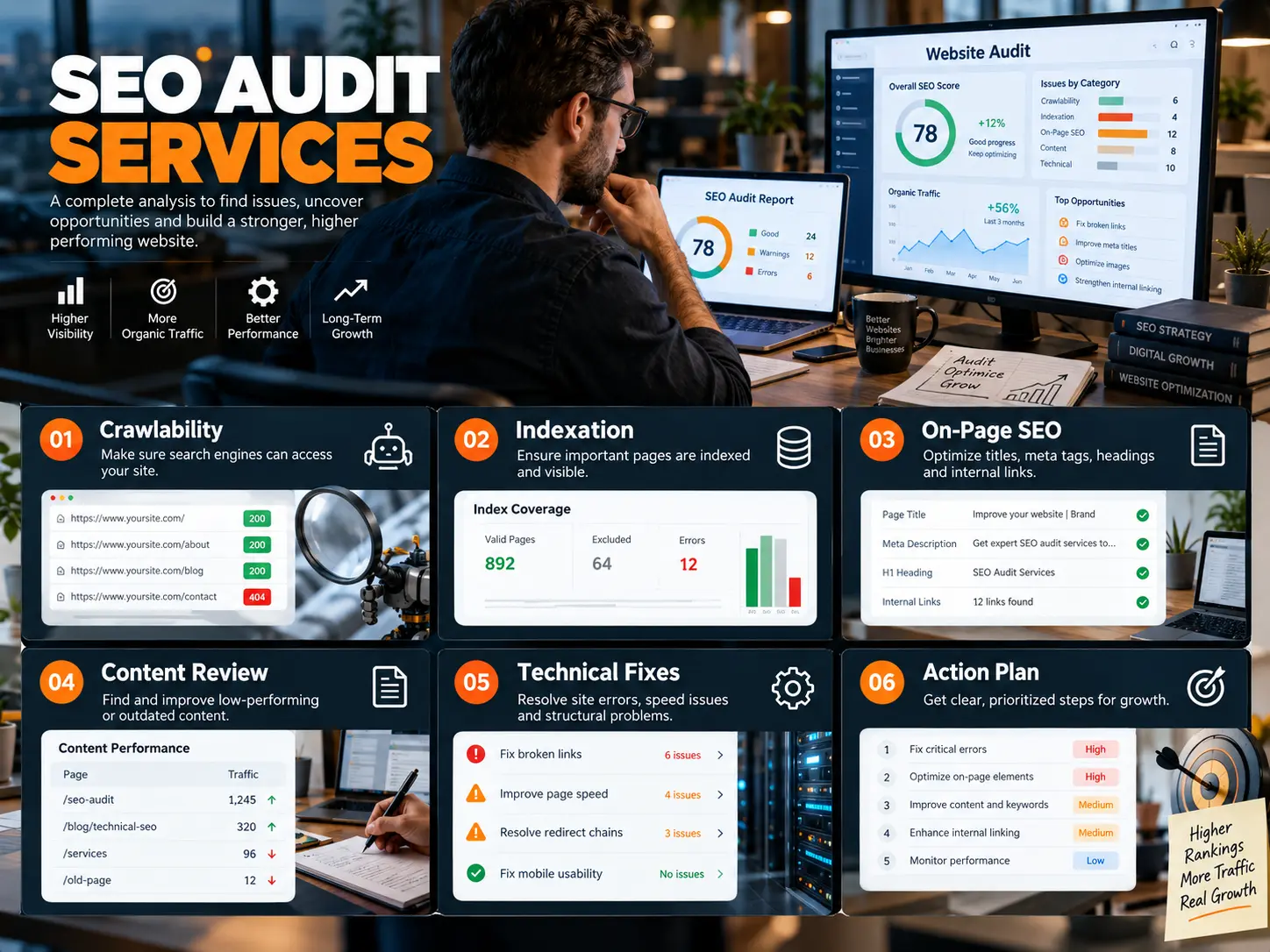
What Are SEO Audit Services?
SEO audit services are a structured evaluation of a website’s organic search performance and underlying SEO health.
A professional audit can cover:
- Technical SEO
- Crawlability and indexing
- On-page SEO
- Content quality and search intent
- Keyword visibility
- Internal linking
- Site architecture
- Structured data
- Page speed and Core Web Vitals
- Mobile usability
- Backlinks and authority
- Local SEO
- Ecommerce SEO
- International SEO
- Analytics and tracking
- Competitor gaps
- AI search visibility
The audit should end with clear priorities, not simply exported tool data.
When Does a Website Need an SEO Audit?
An audit is useful when:
- Organic traffic has declined.
- Rankings have dropped.
- The site has never had a full SEO review.
- A redesign or migration is planned.
- A migration already happened and performance changed.
- Important pages are not being indexed.
- Traffic is growing but leads are not.
- The site has accumulated years of content.
- A new SEO strategy is being planned.
- A business is expanding into new markets.
- An ecommerce catalog has grown significantly.
- Search Console shows recurring technical issues.
Regular audits can also catch problems before they become major losses.
Start With Business and Search Goals
A useful audit should understand what the website is supposed to accomplish.
For a local service company, the priority may be calls and form leads. For ecommerce, it may be category visibility and product revenue. For a publisher, it may be organic audience growth. For B2B, the goal may be qualified demo or consultation requests.
Without business context, an audit can waste time fixing technically valid issues that have little commercial impact.
Technical SEO Audit
Technical SEO asks whether search engines can access, render, understand, and index the right pages efficiently.
Crawlability
Review:
- Robots.txt
- XML sitemaps
- Crawl paths
- Broken links
- Redirect chains
- Orphan pages
- Status codes
- Parameter URLs
- Faceted navigation
The goal is to ensure important pages are easy to discover while low-value or duplicate URLs do not consume unnecessary crawl attention.
Indexation
Compare the pages the site publishes with the pages search engines actually index.
Investigate:
- Noindex tags
- Canonical tags
- Duplicate pages
- Soft 404s
- Redirected URLs
- Search Console indexing reports
- Thin pages
- Accidental staging or test pages
A page cannot rank if it is not eligible for indexing.
JavaScript Rendering
Modern sites can hide important content behind JavaScript. An audit should verify that search engines can access meaningful text, links, product data, navigation, and structured information.
This is especially important for heavily customized ecommerce sites and modern front-end frameworks.
On-Page SEO Audit
On-page SEO evaluates whether individual pages clearly communicate their topic and satisfy search intent.
Review:
- Title tags
- Meta descriptions
- H1 and heading structure
- Page copy
- Search intent alignment
- Keyword cannibalization
- Image alt text
- Internal links
- Anchor text
- URL structure
- Structured data
The goal is not to repeat a keyword more often. The goal is to make each page the clearest and most useful answer for its intended topic.
Content Audit
A content audit asks whether the site has the right pages, whether those pages are useful, and whether older content still deserves to exist.
Classify content into actions such as:
- Keep
- Improve
- Consolidate
- Redirect
- Refresh
- Expand
- Remove
Look for:
- Thin content
- Overlapping articles
- Outdated information
- Weak search intent match
- Missing topic coverage
- Pages with impressions but low clicks
- Pages ranking just outside strong positions
- Content that attracts traffic but no business value
Content decisions should consider both search data and user value.
Internal Linking and Site Architecture Audit
Internal links help users and search engines understand how pages relate to each other.
A good audit checks:
- Important pages buried too deeply
- Orphan pages
- Weak category structures
- Repetitive generic anchor text
- Broken internal links
- Blog posts with no path to services
- Service pages with no supporting content
- Breadcrumb implementation
Strong architecture creates logical topic clusters and distributes authority toward important pages.
Page Speed and Core Web Vitals
Performance affects user experience and can influence search visibility.
Review major page templates rather than testing only the homepage.
Common problems include:
- Oversized images
- Unused JavaScript
- Render-blocking resources
- Heavy third-party scripts
- Slow server response
- Layout shifts
- Poor caching
- Excessive app or plugin load
The best fixes depend on the actual platform and template architecture.
Backlink and Authority Audit
Backlinks remain an important part of organic visibility, but quality matters more than raw counts.
Evaluate:
- Referring domains
- Relevance
- Link quality
- Anchor text patterns
- Lost links
- Competitor authority gaps
- Spam patterns
- Digital PR opportunities
A backlink audit should not turn into panic over every low-quality link. Focus on meaningful patterns and whether the site has enough credible authority to compete.
Local SEO Audit
For local businesses, the audit should also check:
- Google Business Profile completeness
- Categories
- Business information consistency
- Reviews
- Service areas
- Local landing pages
- Local citations
- Map visibility
- On-page location signals
- Local competitors
Local SEO often has different priorities from national organic search.
Ecommerce SEO Audit
Ecommerce websites require additional checks because thousands of products, collections, filters, variants, and out-of-stock pages can create technical complexity.
Review:
- Product and category architecture
- Faceted navigation
- Duplicate product URLs
- Canonicals
- Product structured data
- Internal search pages
- Pagination
- Out-of-stock handling
- Product descriptions
- Collection content
- Internal linking
- Merchant and product feeds where relevant
Large stores should prioritize fixes based on category revenue and search opportunity.
International SEO Audit
For multilingual or multi-country sites, review:
- Hreflang
- Locale architecture
- Canonicals
- Language targeting
- Country-specific keywords
- Localized metadata
- Redirect behavior
- Language switchers
- Regional sitemaps
- Market-specific performance
International errors can cause the wrong country page to rank or prevent local pages from gaining visibility.
Analytics and Conversion Tracking Audit
SEO reporting is incomplete if a business cannot connect organic traffic to meaningful outcomes.
Check whether the site accurately tracks:
- Forms
- Calls
- Purchases
- Revenue
- Demo requests
- Bookings
- Downloads
- Qualified leads
Also review whether analytics excludes internal traffic appropriately and whether major site changes created tracking gaps.
AI Search Visibility Audit
Search discovery increasingly includes AI-generated answers and assistants. An audit can evaluate whether the website provides clear entity information and extractable answers.
Useful checks include:
- Clear brand and service descriptions
- Author and business credibility
- Structured answers to common questions
- Original expertise
- Consistent organization information
- Useful schema where appropriate
- Crawlable content
- Strong topical relationships
This should support traditional SEO fundamentals rather than replace them.
What a Professional SEO Audit Deliverable Should Include
| Deliverable | Purpose |
|---|---|
| Executive summary | Explains the biggest findings in business terms |
| Issue inventory | Documents problems and affected URLs |
| Priority level | Separates critical issues from minor improvements |
| Recommended fix | Explains what should change |
| Expected impact | Helps justify implementation order |
| Ownership | Identifies SEO, content, development, or design responsibility |
| Validation method | Shows how to confirm the fix worked |
| Roadmap | Organizes work into a realistic sequence |
The audit should be understandable to both technical teams and business stakeholders.
How SEO Audit Issues Should Be Prioritized
Not every issue deserves immediate attention.
A practical priority model considers:
- Impact: Could this materially affect visibility or revenue?
- Reach: How many important pages are affected?
- Confidence: Is there strong evidence this is a real problem?
- Effort: How difficult is the fix?
- Dependency: Does another task need to happen first?
For example, fixing a sitewide accidental noindex is more urgent than rewriting a meta description on a page with no impressions.
Common Problems With Low-Quality SEO Audits
They Are Tool Exports
Automated crawlers are valuable, but a spreadsheet of warnings is not a strategy.
They Treat Every Error as Equal
A minor image issue and a serious indexing problem should not have the same priority.
They Ignore Search Intent
Technical fixes cannot rescue a page that does not answer what the searcher wants.
They Do Not Include Implementation Guidance
A business needs to know what to change, who should change it, and how success will be validated.
They Stop at Traffic
The audit should consider leads, revenue, customer journeys, and business priorities.
How Often Should You Get an SEO Audit?
The ideal frequency depends on website size and change rate.
A small stable website may need a deep audit periodically plus ongoing monitoring. A large ecommerce store, publisher, or frequently updated site may need more regular technical and content reviews.
Audits are especially important before and after major redesigns, migrations, platform changes, or international expansion.
Choosing an SEO Audit Service
Ask potential providers:
- Do you manually review findings or only provide automated reports?
- Will you analyze Search Console and analytics data?
- Do you audit content and search intent as well as technical SEO?
- Will issues be prioritized by impact?
- Does the audit include implementation recommendations?
- Can you work with developers or implement fixes?
- Do you have experience with my platform and business model?
- How will results be validated afterward?
Axtronica Digital Studio provides SEO services that can connect auditing with technical fixes, content improvement, website work, and ongoing search strategy.
FAQs
Q1. What do SEO audit services include?
A full audit can include technical SEO, indexing, on-page optimization, content, internal linking, site architecture, backlinks, performance, local SEO, analytics, ecommerce or international SEO, and a prioritized implementation roadmap.
Q2. How long does an SEO audit take?
It depends on site size, platform complexity, data access, and audit depth. A small brochure site can be reviewed much faster than a large ecommerce or international site with thousands of URLs.
Q3. Can I run an SEO audit myself?
Basic checks can be performed with Google Search Console, PageSpeed Insights, analytics, and crawling tools. Professional audits add experience, prioritization, cross-tool analysis, business context, and implementation guidance.
Q4. Will an SEO audit improve rankings by itself?
No. The audit identifies and prioritizes opportunities. Improvements come from implementing the right fixes and continuing to develop useful content, technical quality, and authority.
Q5. What is the difference between a technical SEO audit and a full SEO audit?
A technical audit focuses mainly on crawling, indexing, rendering, architecture, and performance. A full audit also evaluates content, on-page optimization, keywords, internal linking, authority, user intent, and business outcomes.
An Audit Should End With Action
SEO audit services are valuable when they replace guesswork with a clear implementation plan. The best audit does not try to make the report look complicated. It identifies the issues that actually matter, explains them clearly, and organizes the work by business impact.
Once the highest-priority problems are fixed, the site should be monitored and re-evaluated so SEO becomes an ongoing improvement process rather than a one-time checklist.
Tagged with :