
A builder can have excellent craftsmanship, a strong local reputation, and years of completed projects yet still lose new opportunities online. Buyers now research builders long before they request a quote. They compare websites, browse project galleries, read reviews, check locations, study process information, and often return several times before making contact.
Digital marketing for builders should support that research process. The goal is not to chase every possible lead. It is to make the right homeowner, developer, or property owner confident that your company is a good fit for the type of project they are planning.
At Axtronica Digital Studio, we approach builder marketing as a connected buyer journey: discovery, inspiration, validation, consultation, and follow-up. The website, search visibility, project proof, ads, reviews, and content should all move the buyer through those stages.
Table of Contents
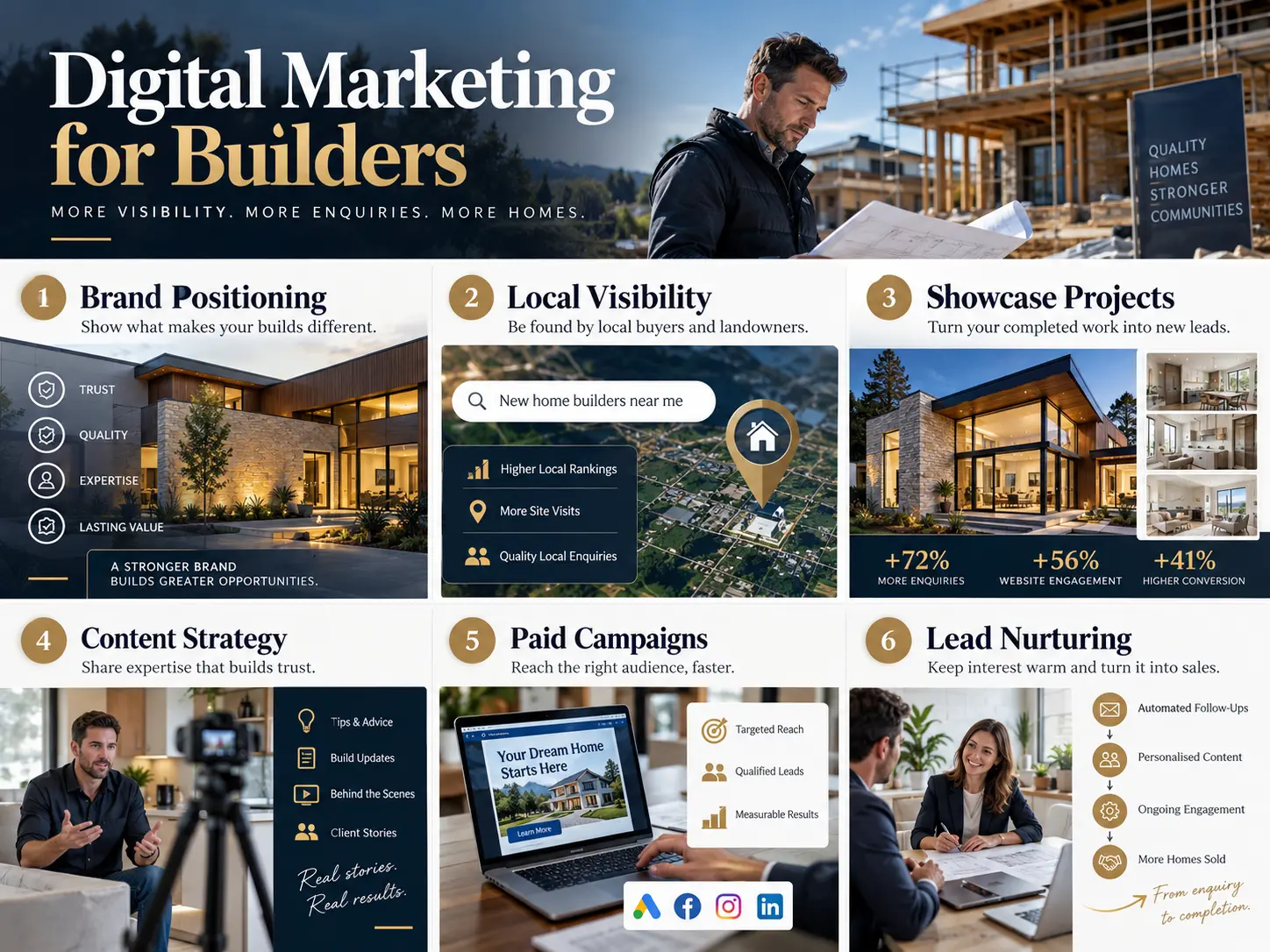
What Digital Marketing for Builders Includes
Builder marketing can include:
- Website strategy and conversion optimization
- Local SEO
- Search engine optimization
- Google Business Profile management
- Google Ads and paid social campaigns
- Project galleries and case studies
- Video and photography
- Social media marketing
- Review generation
- Email nurture
- CRM and lead tracking
- Content marketing
The mix changes depending on whether the business focuses on custom homes, new homes, extensions, renovations, design-build work, multifamily projects, or commercial building.
Understand the Builder Buyer’s Decision Process
Building is rarely an impulse purchase. High-value projects involve financial risk, personal preferences, scheduling, design decisions, permits, and trust.
A buyer may move through several stages:
- Inspiration: collecting ideas and understanding possibilities.
- Education: researching costs, timelines, processes, and builder types.
- Shortlisting: comparing builders, portfolios, reviews, and locations.
- Validation: checking experience, communication, project fit, and reputation.
- Consultation: discussing scope, budget, feasibility, and next steps.
- Decision: evaluating proposals and confidence in the team.
Marketing should provide useful information at every stage rather than pushing every visitor directly to “Get a Quote.”
Build a Website Around Real Projects and Real Decisions
For builders, the website is often the closest thing to a model home a prospect can visit before speaking with the team.
Make Project Types Clear
Create dedicated pages for important services, such as:
- Custom home building
- New home construction
- Home additions
- Whole-home remodeling
- Design-build services
- Luxury home building
- Multifamily construction
- Commercial building
Each page should describe who the service is for, what the process looks like, relevant experience, typical considerations, and the next step.
Create Case Studies, Not Just Galleries
Beautiful photography attracts attention, but buyers also want to know what the builder solved.
A project case study can include:
- Project location
- Property or project type
- Client goals
- Design priorities
- Site constraints
- Construction scope
- Notable materials or features
- Challenges and solutions
- Timeline context
- Finished photography
This turns visual proof into experience-based content.
Explain the Process
Many potential clients have never built a custom home or managed a major construction project. Uncertainty creates hesitation.
Explain key stages in plain language: initial consultation, feasibility, design coordination, budgeting, preconstruction, permitting, construction, selections, inspections, walkthrough, and completion. The exact process depends on the business, but transparency reduces anxiety.
Use Local SEO to Become Visible in the Right Markets
Builders often serve specific cities, counties, developments, or regions. Local SEO helps connect project expertise with those locations.
A strong local strategy includes:
- Accurate Google Business Profile information
- Consistent contact and business details
- Real service areas
- Genuine customer reviews
- Project content tied to real locations
- Location pages where they add meaningful information
- Local internal links
- Mobile-friendly performance
Avoid creating dozens of nearly identical city pages. A location page should deserve to exist because it helps a buyer understand your service in that market.
Build SEO Around High-Value Services and Questions
Builder SEO should cover both commercial intent and research intent.
Potential service terms include custom home builder, home builder, design-build contractor, renovation builder, home addition contractor, luxury home builder, and other relevant specialties.
Supporting content can answer questions such as:
- How do I choose a custom home builder?
- What happens during preconstruction?
- How long does a custom home take to build?
- What affects building costs?
- Design-build vs traditional construction: what is the difference?
- What should I prepare before meeting a builder?
- How are selections and change orders handled?
- What should I look for in a builder’s contract?
Useful content gives prospective clients a reason to trust the company before they are ready to schedule a consultation.
Use Paid Search for High-Intent Builder Queries
Google Ads can capture buyers actively searching for a builder, but high-value projects require careful qualification.
Do not judge campaigns only by form submissions. A builder may prefer fewer leads if those leads match the right budget, location, project type, and timeline.
Landing pages should make expectations clear and show relevant work. If the business builds custom homes above a certain level, the page should communicate positioning through design, photography, process, and project examples rather than trying to appeal to everyone.
Use Paid Social for Inspiration and Retargeting
Builders have a visual advantage on platforms such as Instagram and Facebook. Paid social can be useful for reaching people earlier in the decision process, especially for new communities, custom homes, renovations, or visually distinctive projects.
Strong creative may include:
- Finished home photography
- Before-and-after transformations
- Short project walkthroughs
- Design details
- Construction progress
- Client stories
- Floor plan or lifestyle concepts when appropriate
Retargeting can keep the builder visible to people who already visited project or service pages. Since the buying cycle can be long, repeated visibility may support recall when the prospect becomes ready to talk.
Use Photography and Video as Sales Proof
Builder marketing depends heavily on visual trust. Invest in strong photography for completed work when the project and client permissions allow it.
A useful content library can include:
- Exterior photography
- Interior photography
- Detail shots
- Construction progress
- Drone imagery where lawful and appropriate
- Team and process images
- Video walkthroughs
- Client testimonial videos
Do not only show perfect final spaces. Progress content demonstrates that the company understands the work behind the finished result.
Build Reviews Into the Customer Experience
Reviews help prospective clients evaluate communication, professionalism, problem-solving, cleanliness, schedule management, and overall experience.
For long projects, consider whether there are appropriate milestones for feedback rather than waiting months after completion. Keep the process respectful and never pressure clients to leave a particular rating or wording.
Use relevant testimonials across service and project pages instead of isolating every review on one page.
Nurture Long-Cycle Leads With Email
A custom-home prospect may research for months. A renovation client may wait for financing, design, or a property purchase. Email can keep the builder useful and visible during that period.
Potential email content includes:
- New project tours
- Planning checklists
- Design and material insights
- Construction process education
- Community updates
- New availability or consultation windows
- Helpful articles
The goal is to support decision-making, not fill the inbox with repetitive sales messages.
Track Lead Quality From First Click to Signed Project
| Metric | Why It Matters |
|---|---|
| Website inquiries | Shows raw demand |
| Consultation requests | Indicates stronger intent |
| Qualified lead rate | Measures project fit |
| Cost per qualified lead | Connects spend to useful opportunities |
| Consultation-to-proposal rate | Shows sales progression |
| Proposal-to-close rate | Measures closing performance |
| Average project value | Helps prioritize channels and services |
| Revenue by source | Identifies the channels creating real value |
| Sales cycle length | Helps plan follow-up and forecasting |
Builders should also record why leads are disqualified. Common reasons such as location, budget, project type, or timeline can reveal whether marketing messages need to be clearer.
Common Builder Marketing Mistakes
Showing Beautiful Work Without Explaining It
A gallery can inspire, but a case study builds confidence. Add context to important projects.
Targeting Too Broad an Audience
Trying to market to everyone often produces poor-fit inquiries. Clear positioning can reduce lead volume while improving lead quality.
Hiding the Process
First-time building clients are anxious about what happens next. Process transparency is a competitive advantage.
Ignoring Follow-Up
A high-value prospect may not be ready today. A structured CRM and nurture process prevents strong opportunities from disappearing.
Redesigning a Website Without Protecting SEO
If an established builder changes its website, URLs, content, and navigation carelessly, existing search visibility can be lost. Redesigns should include a migration and redirect plan.
A Practical Digital Marketing Plan for Builders
- Define your ideal project type, value, buyer, and service area.
- Improve the website around services, projects, process, and conversion.
- Strengthen local SEO and Google Business Profile.
- Build organic search content around services and buyer questions.
- Create a professional photography and video workflow.
- Launch focused paid search for high-intent demand.
- Use paid social and retargeting where the visual buyer journey supports it.
- Collect reviews and testimonials consistently.
- Nurture long-cycle prospects through email and CRM follow-up.
- Measure qualified opportunities and signed project value by source.
Axtronica Digital Studio can support this process with website design, SEO, digital marketing, and conversion strategy built around the way high-consideration buyers make decisions.
FAQs
Q1. What is digital marketing for builders?
It is the use of websites, SEO, local search, paid advertising, project content, social media, reviews, email, and analytics to help builders attract and convert qualified project opportunities.
Q2. What marketing works best for home builders?
For many home builders, the strongest mix includes a visually credible website, project case studies, local SEO, Google Business Profile, reviews, search advertising, social media, video, and long-term lead nurture.
Q3. How important is SEO for builders?
SEO is important because buyers search for builders by service, location, project type, and planning questions. Strong organic visibility can support both immediate inquiries and early-stage research.
Q4. Should builders publish pricing?
There is no universal answer. Some builders publish ranges or cost factors to qualify leads and educate buyers, while others prefer consultation-based pricing because project scope varies widely. Whatever approach is used, the website should help visitors understand whether the company is likely to fit their project.
Q5. What should a builder include in a project case study?
Include the project type, goals, scope, design or site considerations, challenges, solutions, key features, photos, and relevant client feedback. Focus on the decisions and work behind the final result.
Build Trust Before the First Consultation
Digital marketing for builders is most effective when it makes the buying process easier. A prospect should be able to see what you build, understand how you work, explore relevant projects, learn from your expertise, and know exactly how to start a conversation.
When those elements are supported by SEO, local visibility, paid acquisition, strong visuals, reviews, and lead tracking, marketing becomes a structured extension of the builder’s sales process rather than a collection of disconnected promotions.
Tagged with :