
Digital Marketing for HVAC Companies requires a balanced strategy that combines local SEO, targeted paid advertising, service-specific landing pages, customer reviews, and seasonal campaigns to generate consistent leads throughout the year.
At the same time, the most profitable HVAC businesses cannot live on emergency repair calls alone. Installations, replacements, heat pumps, indoor air quality, ductwork, maintenance memberships, and commercial service all require a longer decision process.
That is why digital marketing companies should cover both sides of the customer journey: immediate demand and planned demand. Axtronica Digital Studio recommends building the strategy around local visibility, service-specific pages, reviews, paid search, seasonal planning, strong call handling, and measurement that connects leads to booked work.
Table of Contents
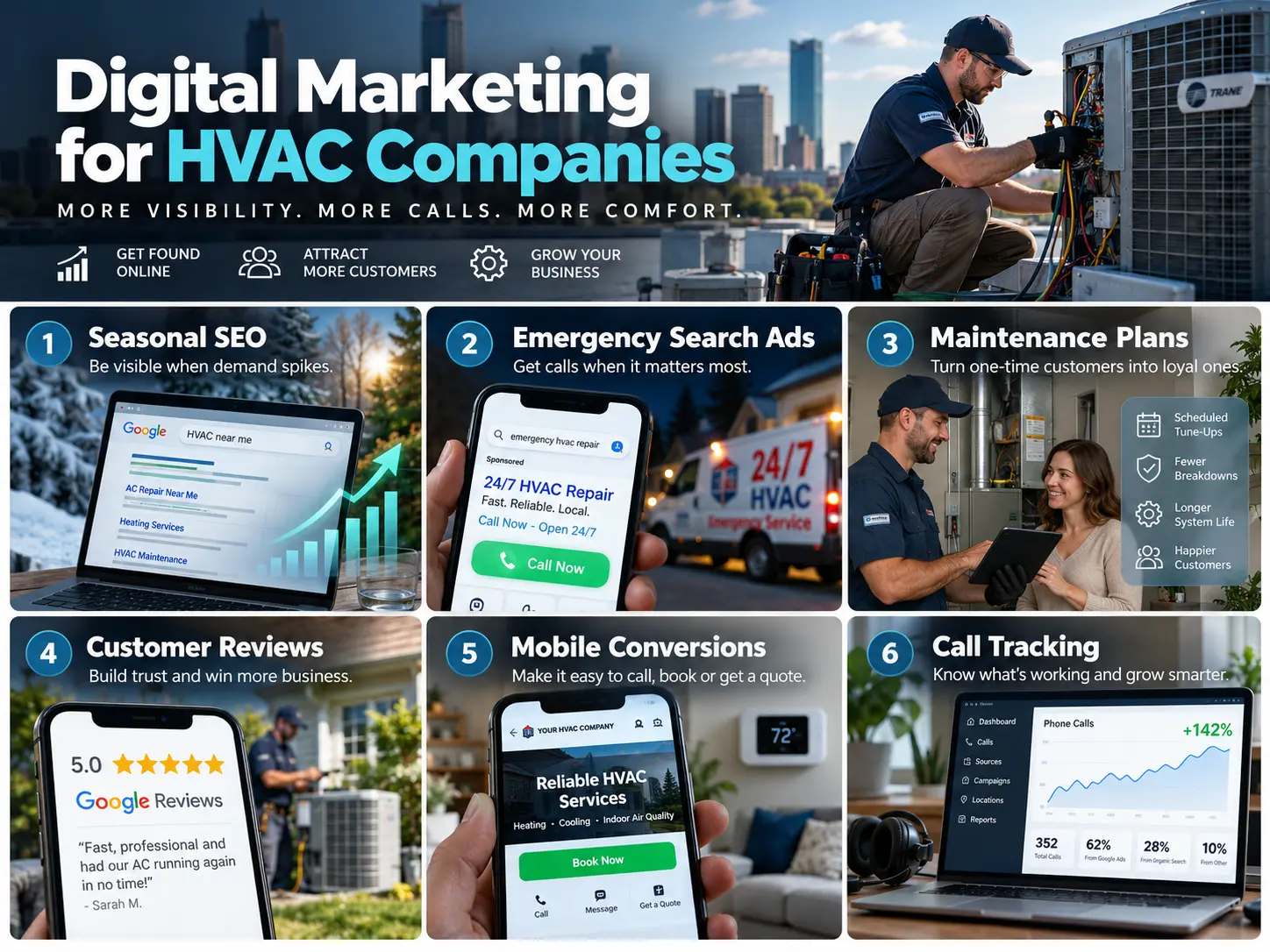
Digital Marketing for HVAC Companies: Why HVAC Marketing Is Different
HVAC demand is local, seasonal, and often urgent. Search behavior changes with weather, equipment age, utility costs, homeowner priorities, and local housing conditions.
The same company may need to market very different services throughout the year:
- Air conditioner repair
- AC replacement and installation
- Furnace repair
- Furnace replacement
- Heat pump installation and service
- Ductless mini-split systems
- HVAC maintenance
- Indoor air quality
- Ductwork
- Thermostats and controls
- Commercial HVAC
- Emergency HVAC service
A generic “heating and cooling” page is rarely enough to cover all of those needs well.
Map Marketing to HVAC Search Intent
| HVAC Search Type | Customer Situation | Best Digital Experience |
|---|---|---|
| Emergency repair | System is not working | Local search visibility, tap-to-call, immediate service information |
| Replacement | Comparing major investment | Detailed options, financing information, reviews, estimate CTA |
| Maintenance | Preventive need | Membership benefits, scheduling, reminders |
| Heat pump research | Evaluating technology | Educational content, suitability, installation page |
| Indoor air quality | Symptom or comfort concern | Problem-focused content, product/service options |
| Commercial HVAC | Business continuity | Capabilities, maintenance, project proof, business contact path |
Understanding intent helps prevent a common mistake: sending every visitor to the homepage.
Win Local Search Before the Weather Changes
The worst time to start building local visibility is the first day of a heat wave. Local SEO works best when the foundation is already established.
Keep your Google Business Profile accurate and complete. Use the right categories, maintain current hours, add real service areas, list genuine services, and upload authentic photos of technicians, vehicles, equipment, maintenance work, and installations.
Reviews should be collected continuously. Customers often mention responsiveness, communication, cleanliness, diagnosis, pricing clarity, and whether the system was fixed correctly. Those details help future prospects evaluate the company.
Build a Strong HVAC Website Around Services
A useful HVAC website should make it easy for someone to identify the exact help they need.
Create dedicated pages for priority services rather than forcing all topics into one page. A replacement page should answer different questions from a repair page. A commercial page should speak differently from a residential maintenance page.
Strong HVAC service pages can include:
- Common symptoms or reasons the service is needed
- What the service covers
- Equipment or system types handled
- What customers can expect from the visit
- Relevant trust signals
- Financing information when applicable
- Service areas
- FAQs
- Scheduling or estimate CTA
Avoid promises such as guaranteed arrival times unless operations can consistently support them.
Use SEO to Build Year-Round Demand
HVAC SEO should cover immediate service intent and research intent.
High-Intent Service Keywords
Examples include AC repair, furnace repair, HVAC replacement, heat pump installation, mini-split installation, commercial HVAC service, and HVAC maintenance.
Local Keywords
Combine real services with genuine service areas. Build location content only where the business actually operates and can provide useful local information.
Educational Topics
Educational content can answer questions customers ask before they schedule:
- Why is my AC running but not cooling?
- How long does an HVAC system last?
- Repair or replace: how do I decide?
- What size HVAC system do I need?
- How often should HVAC maintenance be scheduled?
- Are heat pumps effective in my climate?
- What causes uneven temperatures between rooms?
- Why is my energy bill suddenly higher?
The goal is not to stuff service keywords into every paragraph. It is to create enough useful coverage that the site becomes a trusted resource around the problems customers are trying to solve.
Use Paid Search for Seasonal and Emergency Demand
Google Ads can be especially effective in HVAC because many searches have immediate buying intent. Campaign structure should reflect the service, location, and urgency.
For example, “AC repair” and “AC replacement” should not necessarily use the same ads, landing pages, or bidding strategy. One buyer needs a diagnosis; the other may be comparing a major purchase.
Negative keywords help filter searches for DIY repair, training, jobs, parts, manuals, wholesale equipment, and other non-customer intent.
Local Services Ads may be available to eligible HVAC businesses in supported markets. Where they are available, treat them as one piece of the acquisition mix and measure them by booked jobs and customer value, not lead volume alone.
Prepare Campaigns Before Peak Season
Seasonal HVAC demand rewards preparation. Do not wait for the temperature to change before updating pages, budgets, ads, and staffing.
A practical seasonal process includes:
- Review last season’s lead sources and close rates.
- Update priority service pages before demand rises.
- Confirm call tracking and form tracking.
- Refresh ad copy and negative keywords.
- Check Google Business Profile hours and service information.
- Prepare maintenance, replacement, and financing messaging.
- Make sure the team can respond to increased call volume.
Marketing and operations have to be aligned. Driving more calls than the office can answer wastes budget and harms customer experience.
Promote Maintenance Plans as a Relationship Strategy
Maintenance memberships can reduce the dependence on one-time emergency transactions. They create recurring touchpoints and give customers a reason to stay connected with the company.
A maintenance page should clearly explain what is included, how often service occurs, what benefits members receive, and what is not included. Email and SMS reminders can support scheduling when customers have opted in.
The marketing value is long term: a customer who trusts the company for maintenance may be more likely to call the same company when a repair or replacement is eventually needed.
Build Trust Around Major HVAC Replacements
Replacement customers need more information than emergency repair customers. They may compare equipment options, efficiency, comfort, warranties, financing, installation quality, and long-term operating costs.
Useful replacement content can discuss:
- Signs replacement may be worth considering
- Repair-versus-replace factors
- Equipment types
- Efficiency concepts in plain language
- Sizing and load considerations
- Installation process
- Comfort and airflow considerations
- Financing options when offered
- Warranty and maintenance expectations
Do not reduce a major purchase to a price-only message. The installation process, contractor quality, and system suitability matter.
Use Content to Explain HVAC Problems Without Encouraging Unsafe Work
Helpful HVAC content can guide homeowners through simple observations and preparation, but it should be clear about the line between basic maintenance and work that requires a trained professional.
Articles can explain symptoms, possible causes, questions to ask, what a technician may inspect, and when to stop troubleshooting and schedule service. This approach is useful to readers and protects the brand from publishing risky DIY instructions involving electrical components, refrigerants, gas systems, or other hazards.
Make Reviews and Proof Easy to Find
Do not hide every review on a testimonial page. Place relevant proof near the decision point.
- Repair reviews can support repair pages.
- Installation reviews can support replacement pages.
- Commercial testimonials can support business services.
- Maintenance feedback can support membership pages.
Case studies are also useful for complex replacement, commercial, or comfort projects. Explain the original problem, the assessment, the solution chosen, and the outcome without inventing performance claims.
Improve Conversion From Mobile Visitors
HVAC traffic is heavily influenced by mobile behavior, especially for urgent service. The mobile experience should prioritize:
- Tap-to-call buttons
- Clear scheduling options
- Service area information
- Hours and availability
- Fast-loading pages
- Reviews and trust signals
- Short forms
- Clear repair, replacement, and maintenance paths
A visually impressive site that makes the phone number difficult to find is not a strong HVAC website.
Track the Metrics That Connect Marketing to Revenue
| Metric | Why It Matters |
|---|---|
| Calls and forms | Shows raw lead volume |
| Qualified lead rate | Measures relevance of inquiries |
| Booking rate | Shows how well leads become appointments |
| Cost per booked call | Better indicator than cost per click |
| Average ticket | Helps compare service categories |
| Replacement opportunity rate | Shows how repair demand feeds larger sales |
| Maintenance-plan conversions | Measures recurring relationship growth |
| Close rate | Shows sales performance |
| Revenue by channel | Reveals which marketing sources create value |
A campaign that generates cheaper leads can still be worse if those leads do not book or buy.
Common HVAC Marketing Mistakes
Turning Ads Up Without Checking Capacity
If calls go unanswered, the campaign is not truly scalable. Marketing planning should consider dispatch, technician capacity, office coverage, and after-hours handling.
Using One Page for Every Service
Repair, replacement, maintenance, indoor air quality, and commercial service involve different questions. Separate pages improve both user clarity and search relevance.
Waiting Until Peak Season to Do SEO
Organic visibility takes time to build. Prepare content and local signals before demand spikes.
Chasing Traffic From Outside the Service Area
Clear location targeting protects both organic relevance and ad budget.
Publishing Generic AI-Style Content With No Local or Technical Context
HVAC content should sound like it understands real systems, customer concerns, climate patterns, and service decisions. Generic filler is easy to ignore.
A Practical HVAC Marketing Framework
- Identify the services and customer types that matter most.
- Fix local listings, reviews, tracking, and mobile conversion.
- Build strong service pages for repair, installation, maintenance, and specialty work.
- Develop local SEO around real service areas.
- Prepare paid search before seasonal demand rises.
- Publish useful content around symptoms, decisions, and maintenance.
- Promote maintenance relationships and repeat business.
- Track booked jobs, revenue, and customer value by channel.
- Reinvest in the service lines producing profitable growth.
Axtronica Digital Studio can support the full system with SEO, website design, paid media, and conversion-focused digital strategy rather than treating each channel as a separate project.
FAQs
Q1. What Is the Best Digital Marketing Strategy for HVAC Companies?
A strong foundation usually combines local SEO, a complete Google Business Profile, service-specific website pages, reviews, paid search, fast mobile conversion, and reliable lead tracking. Seasonal planning and maintenance marketing are especially important for HVAC.
Q2. Does SEO work for HVAC companies?
Yes. SEO can capture emergency repair searches, installation research, maintenance questions, and local service queries. It works best when the website has useful service pages and genuine local relevance.
Q3. Should HVAC companies run Google Ads?
Paid search can be effective for high-intent services when the campaign uses tight geographic targeting, relevant landing pages, negative keywords, and call tracking. Results should be evaluated by booked jobs and revenue.
Q4. What should an HVAC company post online?
Useful content includes maintenance advice, system explanations, seasonal preparation, project examples, technician introductions, replacement guidance, comfort tips, and answers to common homeowner questions.
Q5. How can an HVAC company get more replacement leads?
Create strong replacement and installation pages, publish repair-versus-replace guidance, show credible reviews and project proof, explain financing when available, use paid search for replacement intent, and train the team to identify genuine replacement opportunities without pressure.
Build an HVAC Marketing System Before the Next Demand Spike
Digital marketing for HVAC companies works best when the foundation is already in place before customers urgently need help. Local visibility, service pages, reviews, paid search, seasonal planning, and call handling should operate as one system.
That system helps the business capture emergency demand today while also building the maintenance relationships and replacement opportunities that support long-term growth.