


Construction has always been a relationship-driven business. Referrals from developers, property managers, architects, homeowners, and previous clients still matter, but referrals alone are difficult to scale or predict. A construction company that wants a steadier pipeline needs to be visible before a prospect starts building a shortlist.
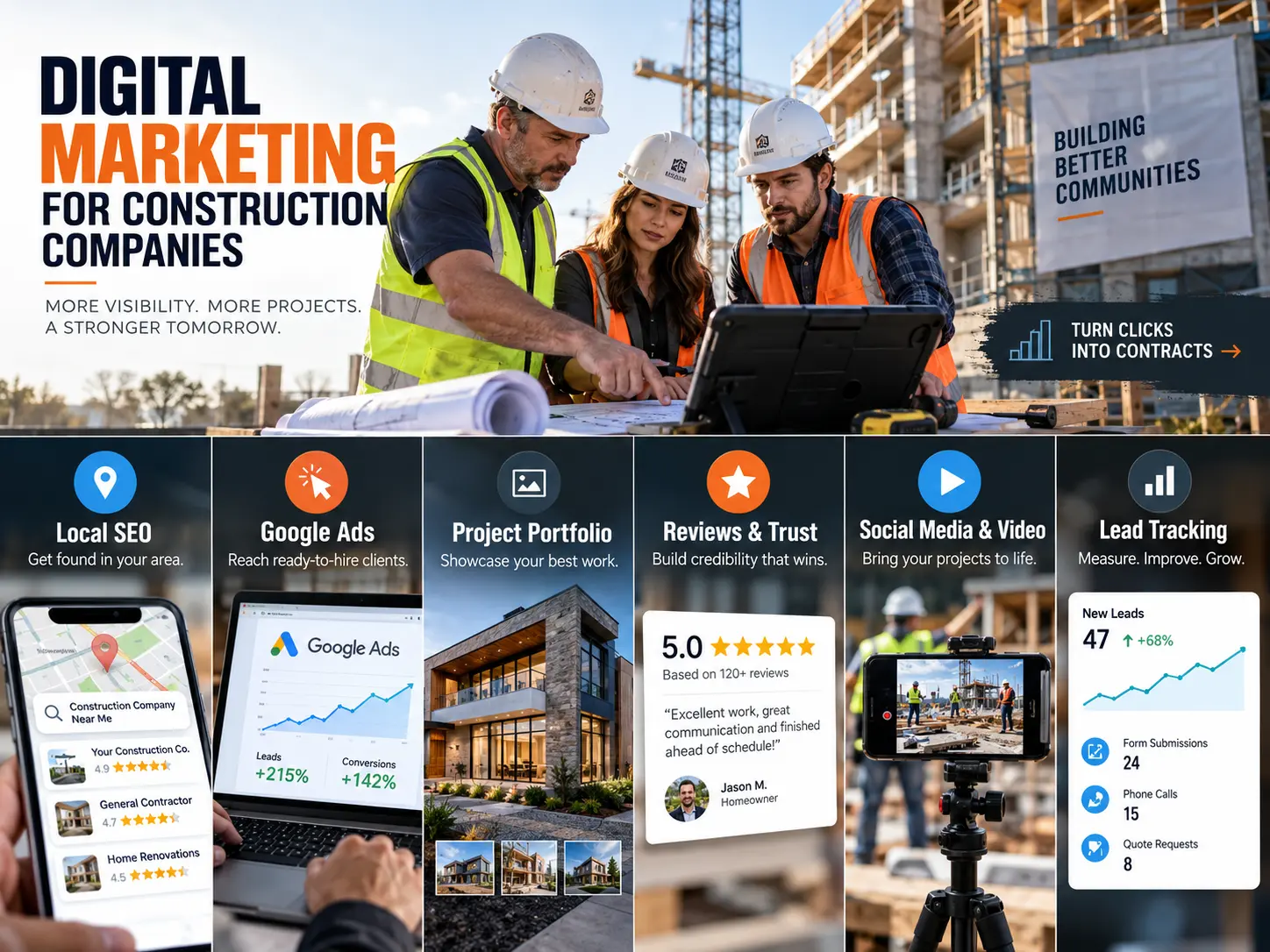
That is the real purpose of digital marketing for construction companies. It is not simply about posting on social media or buying clicks. It is about creating a connected system that helps the right buyer find your company, understand what you build, trust your experience, and take the next step.
At Axtronica Digital Studio, we recommend treating construction marketing like a project plan: start with the foundation. A conversion-ready website, accurate local presence, strong service and project pages, useful content, paid search, reviews, and lead tracking should support one another instead of operating as unrelated tactics.
Table of Contents
What Digital Marketing Means for a Construction Company
Digital marketing for construction companies uses online channels to create visibility, demonstrate capability, and generate qualified project inquiries. Depending on the business model, the mix can include:
- Search engine optimization (SEO)
- Local SEO and Google Business Profile optimization
- Google Ads and other paid search campaigns
- Construction website design and conversion optimization
- Project portfolios and case studies
- Content marketing
- Social media and LinkedIn marketing
- Video and jobsite content
- Review and reputation management
- Email nurture and remarketing
- Analytics, call tracking, and CRM reporting
The important part is not how many channels you use. It is whether the channels lead prospects toward a clear decision.
Construction Buyers Need More Than a Sales Pitch
Construction is a high-trust purchase. A homeowner may be placing a large portion of personal savings into a renovation or custom home. A commercial decision-maker may be responsible for schedule, budget, safety, disruption, and multiple stakeholders.
Before contacting a contractor, buyers commonly want to know:
- Does this company handle my type of project?
- Does it work in my location?
- Can I see completed work that is relevant to my needs?
- Does the company look established and credible?
- What do previous clients say?
- Does the team communicate professionally?
- Is there a clear way to discuss a project or request an estimate?
A useful digital presence answers those questions before the sales conversation begins.
Residential and Commercial Construction Require Different Marketing
A residential builder and a commercial general contractor may both work in construction, but their buyers evaluate them differently.
| Marketing Factor | Residential Construction | Commercial Construction |
|---|---|---|
| Primary buyer | Homeowner or family | Owner, developer, facility manager, procurement team |
| Search behavior | Strong local and service intent | Capability, sector, project type, and location intent |
| Trust signals | Reviews, photos, testimonials, warranties | Case studies, capabilities, safety, experience, documentation |
| Typical CTA | Request an estimate | Discuss a project, submit an RFP, schedule a consultation |
| Strong content | Cost, process, inspiration, timelines | Delivery methods, sectors, case studies, planning, risk reduction |
| Sales cycle | Often shorter | Often longer and multi-stakeholder |
This distinction should shape the website, SEO strategy, advertising, content, and conversion path.
Build a Website That Works Like a Digital Sales Team
A construction website should do more than look professional. It should help a prospect qualify your company without having to call for basic information.
Create Separate Service Pages
Avoid placing every capability on one general services page. If you offer commercial construction, tenant improvements, design-build, renovations, construction management, custom homes, additions, or remodeling, important services deserve dedicated pages.
A focused service page can explain scope, process, ideal project types, common questions, relevant projects, service areas, and the next step. It also gives search engines a clearer understanding of the page topic.
Turn Portfolio Images Into Project Case Studies
A gallery proves that work happened. A case study explains what the team actually accomplished.
For important projects, include:
- Project type and location
- Client objective
- Scope of work
- Site or scheduling constraints
- Construction approach
- Key materials or systems
- Coordination challenges
- Before, progress, and completed images
- Final outcome
The strongest project pages provide context. A polished photograph is more persuasive when the reader understands the complexity behind it.
Make the Next Step Obvious
Use calls to action that match construction intent, such as “Discuss Your Project,” “Request an Estimate,” “Schedule a Consultation,” or “Submit Project Details.” Forms should gather enough information to qualify the inquiry without becoming a barrier.
Use SEO to Capture High-Intent Construction Searches
Construction SEO should be built around the way real buyers search, not around a long list of repeated keywords.
A practical keyword structure includes four groups.
Service Keywords
These describe what the company actually does: commercial construction, general contracting, design-build, tenant improvements, custom home building, remodeling, industrial construction, and similar services.
Location Keywords
Local intent often appears in searches such as “general contractor in [city]” or “commercial construction company near me.” Location pages can be valuable when they represent genuine service areas and contain useful local information. Thin pages that simply swap city names rarely help users.
Sector and Project-Type Keywords
Commercial contractors can build relevance around the industries they genuinely serve, such as healthcare, office, industrial, retail, hospitality, education, or warehouse projects.
Informational Keywords
Prospects search for answers before they are ready to hire. Useful topics include timelines, permitting, preconstruction, renovation planning, design-build comparisons, cost factors, occupied-building work, and contractor selection.
This creates topical authority because the website explains both the service and the decisions surrounding the service.
Strengthen Local SEO and Google Business Profile Visibility
For contractors working within defined service areas, local visibility is often one of the highest-value opportunities.
Keep business information consistent across the website, Google Business Profile, and credible business listings. Select accurate categories, maintain current hours and contact details, define real service areas, and add genuine project photos regularly.
Reviews also matter because they help buyers evaluate communication, reliability, workmanship, and professionalism. A consistent review process works better than asking for a large batch once a year. Request feedback after meaningful milestones or successful completion, and encourage clients to describe their experience in their own words.
Use Google Ads to Reach Buyers With Immediate Intent
Paid search can put a construction company in front of prospects who are actively searching for a contractor. The most useful campaigns usually focus on commercially meaningful services and locations rather than broad traffic.
A strong journey looks like this:
Search -> Relevant Ad -> Matching Service Page -> Project Proof -> Clear CTA
If someone searches for an office renovation contractor, sending that person to a generic homepage creates extra work. A focused office renovation landing page with relevant projects and a clear consultation path is more useful.
Negative keywords are equally important. Construction campaigns can attract job seekers, students, equipment shoppers, DIY searches, software research, and unrelated trades. Filtering irrelevant intent protects the budget.
Create Content From Questions Your Team Already Answers
The best construction content often starts in sales calls, site meetings, estimating conversations, and preconstruction discussions.
If prospects regularly ask questions such as “How long will this take?”, “Can we stay open during the work?”, “What happens before construction starts?”, or “How are change orders handled?”, those questions can become valuable articles, FAQs, or service-page sections.
Practical detail signals expertise. Explain scheduling realities, access planning, coordination, material considerations, permitting, safety, communication, and what owners should prepare before work begins. Helpful specificity is more credible than generic claims about quality.
Turn Every Completed Project Into Multiple Marketing Assets
A finished project can support marketing long after the final walkthrough. One project can become:
- A detailed portfolio page
- A written case study
- Before-and-after content
- A short jobsite video
- A testimonial
- A Google Business Profile update
- A LinkedIn post
- Social media posts
- An email feature
- Supporting visuals for related service pages
This is one of the most efficient ways to create original, experience-based content because the source material comes directly from work the company has completed.
Use Social Media to Show Activity, Not Just Promotion
Construction is visual, so social media can document progress in a way many industries cannot. Useful content includes jobsite updates, completed spaces, team features, safety practices, material choices, short educational videos, and behind-the-scenes coordination.
For commercial contractors, LinkedIn can be especially useful because developers, property managers, architects, facility leaders, and business owners use it professionally. The goal is not to sell in every post. Consistent evidence of real work keeps the company visible when a future need develops.
Use Video to Reduce Uncertainty
A short walkthrough of an actual project can communicate scale, process, and professionalism quickly. Video formats can include completed project tours, progress updates, client testimonials, drone footage, project manager explanations, and team introductions.
Whenever possible, add context. Explain what viewers are seeing, why a construction decision was made, or how a challenge was handled. Educational video tends to build more trust than a highlight reel with no explanation.
Connect Marketing to Lead Follow-Up
A website inquiry is not the finish line. Marketing performance depends on what happens after the lead arrives.
A simple process can look like this:
- The inquiry enters through phone, form, email, or ad.
- The lead is recorded in a CRM or tracking system.
- The prospect receives confirmation.
- A team member reviews project fit.
- Qualified prospects receive a prompt response.
- Follow-up is scheduled and documented.
- The opportunity is tracked through estimate, proposal, and close.
- The original marketing source stays attached to the opportunity.
Without this connection, it is easy to overvalue channels that generate many weak leads and undervalue channels that generate fewer but better projects.
Measure Qualified Pipeline, Not Vanity Metrics
Website traffic, impressions, and clicks are useful diagnostic metrics, but they do not tell the full business story.
| Metric | Why It Matters |
|---|---|
| Organic visibility | Shows whether relevant search presence is improving |
| Conversion rate | Measures how often visitors take a meaningful action |
| Cost per lead | Shows basic acquisition efficiency |
| Qualified lead rate | Reveals whether marketing attracts the right projects |
| Cost per qualified lead | Connects spend to usable opportunities |
| Proposal rate | Shows how many leads progress into real sales activity |
| Close rate | Measures how often proposals become customers |
| Project value | Helps compare lead sources by revenue potential |
| Customer acquisition cost | Shows the true cost to win a customer |
| Marketing ROI | Connects marketing investment with business return |
A smaller campaign that creates the right project opportunities can be more valuable than a campaign that produces large volumes of unqualified calls.
Common Construction Marketing Mistakes
Using a Generic Website
Statements such as “quality work you can trust” sound positive but do not help a buyer understand what the company specializes in. Specific services, sectors, projects, locations, and processes create stronger credibility.
Relying on Stock Photography
Stock images can support a layout, but they should not replace real project evidence. Buyers want to see what your team has actually built.
Publishing Random Blog Posts
Content should support real services and client questions. A focused topic cluster around a profitable service is usually more useful than disconnected weekly posts.
Measuring Only Traffic
Traffic without lead quality can create false confidence. Track the path from visitor to inquiry, qualified opportunity, proposal, and closed project.
Ignoring Mobile Experience
Prospects often research contractors from a phone. Pages should load quickly and make it easy to call, browse projects, read service information, and submit a form.
SEO or PPC: Which Is Better for Construction Companies?
Most construction companies should not frame the decision as SEO versus PPC. The two channels solve different problems.
| SEO | PPC |
|---|---|
| Builds organic visibility over time | Creates immediate visibility |
| Creates durable service and content assets | Can target specific services quickly |
| Supports topical authority | Useful for high-intent demand |
| Requires patience and consistency | Requires ongoing budget and optimization |
| Can capture multiple research stages | Works best with strong landing pages |
A balanced strategy may use PPC for immediate demand while SEO builds long-term visibility and authority.
A Practical Construction Marketing Plan
Start in this order:
- Define the project types, locations, and clients you want most.
- Audit the website, local presence, reviews, tracking, and existing content.
- Fix service pages, project proof, mobile experience, and conversion paths.
- Build SEO around profitable services, locations, sectors, and client questions.
- Strengthen Google Business Profile and review generation.
- Add paid search once landing pages and tracking are reliable.
- Turn active and completed projects into original content.
- Measure qualified opportunities and reinvest in what produces real business.
Axtronica Digital Studio combines website strategy, SEO, paid media, content, and conversion-focused digital marketing so the individual pieces work as one system rather than isolated campaigns.
FAQs
Q1. What is digital marketing for construction companies?
It is the use of websites, SEO, local search, paid advertising, content, social media, video, reputation management, and analytics to help construction companies become discoverable, demonstrate capability, and generate qualified project inquiries.
Q2. Does SEO work for construction companies?
Yes, when the strategy targets genuine services, relevant locations, project types, and useful questions. Strong service pages and project case studies are especially important because construction buyers need evidence as well as information.
Q3. Are Google Ads useful for contractors?
They can be effective for high-intent searches when campaigns use careful location targeting, relevant keywords, negative keywords, strong landing pages, and conversion tracking. Lead quality should be measured alongside lead volume.
Q4. What should construction companies post on social media?
Useful content includes project progress, before-and-after transformations, completed work, team expertise, safety practices, jobsite videos, material explanations, client feedback, and community involvement.
Q5. How can a construction company get better leads?
Clarify the ideal project profile, improve service and project pages, strengthen local visibility, publish useful proof, run focused advertising, and track which channels create qualified opportunities rather than simply counting inquiries.
Build a Marketing System That Matches How Construction Is Sold
The strongest digital marketing for construction companies reflects the way clients actually choose a contractor. Buyers want to understand capability, see relevant work, verify reputation, reduce risk, and know what to do next.
SEO helps them find you. Paid search captures immediate demand. Project case studies prove experience. Reviews reduce uncertainty. Content answers important questions. A conversion-focused website connects those signals and turns attention into a conversation.
When these elements work together, digital marketing becomes more than promotion. It becomes a predictable support system for business development.