Searching for “graphic design near me” usually means you need more than a random template. You may need a logo, flyer, brochure, business card, signage, packaging, social media graphics, presentation, print file, or a designer who can keep several brand materials consistent.
The best designer is not always the one physically closest to you. Location matters when a project involves on-site meetings, measurements, local printing, photography, installation, or fast physical proofs. For many digital and print projects, however, a well-organized remote team can provide the same collaboration through video calls, shared files, proofs, and clear project management.
The better question is: who can understand the business, produce professional work, prepare the right files, communicate clearly, and deliver consistently?
Axtronica Digital Studio provides branding and design services for businesses that need that broader system, not simply a one-off graphic.
Table of Contents
What Does a Graphic Designer Actually Do?
Graphic design is visual problem-solving. A designer organizes words, images, colors, typography, and layout so a message is easier to understand and more persuasive.
Common services include:
- Logo design
- Brand identity
- Business cards
- Flyers
- Brochures
- Postcards
- Social media graphics
- Digital ads
- Presentation design
- Packaging
- Signage
- Trade show graphics
- Menus
- Print-ready artwork
- Website graphics
- Infographics
Some designers specialize. A logo designer may not be the best person for a 60-page annual report. A social media designer may not have experience preparing large-format files for a commercial printer. Match the portfolio to the actual project.
Local Designer vs Remote Design Team
| Local Graphic Designer | Remote Graphic Design Team |
|---|---|
| Easy in-person meetings | Wider choice of specialists |
| Useful for local print/vendor coordination | Convenient digital collaboration |
| Helpful for site visits and measurements | Often easier to scale across many asset types |
| Familiar with local market context | Can support businesses across multiple locations |
| Physical proofing may be simpler | Shared proofs and revision systems can be faster |
Neither option is automatically better. The project determines how important physical proximity really is.
When Hiring a Local Graphic Designer Makes Sense
A nearby designer can be especially useful when the project requires:
- Site measurements for signage
- Frequent in-person workshops
- Local event materials
- Print shop coordination
- Physical packaging prototypes
- Environmental graphics
- Local photography coordination
- Installation supervision
In those cases, proximity can reduce logistics.
When Remote Graphic Design Works Just as Well
Remote collaboration is often suitable for:
- Logo design
- Brand guidelines
- Social media graphics
- Digital advertising
- Website graphics
- Business cards
- Flyers and brochures
- Presentations
- Email graphics
- Print-ready artwork
A good remote process should include a written brief, clear milestones, proofing, revision control, and final file delivery.
Start With the Portfolio, Not the Sales Pitch
Before hiring, look at the designer’s actual work.
Ask:
- Does the portfolio show the type of project I need?
- Is the work visually consistent and well organized?
- Does every project look identical, or can the designer adapt to different brands?
- Are typography and spacing handled professionally?
- Are there examples of both digital and print production if I need both?
- Does the designer show complete systems, not just isolated mockups?
A polished mockup can make weak design look impressive. Pay attention to the design itself, not only the presentation background.
Check Whether the Designer Understands Brand Consistency
If you need several assets, they should feel as if they belong to the same company.
A consistent visual system may define:
- Logo usage
- Color palette
- Typography
- Icon style
- Image treatment
- Layout principles
- Graphic elements
- Spacing
- Tone and messaging hierarchy
This is why branding experience matters. A designer who only creates individual graphics may struggle to maintain consistency across a website, flyer, social post, sign, and sales presentation.
Ask About the Design Process
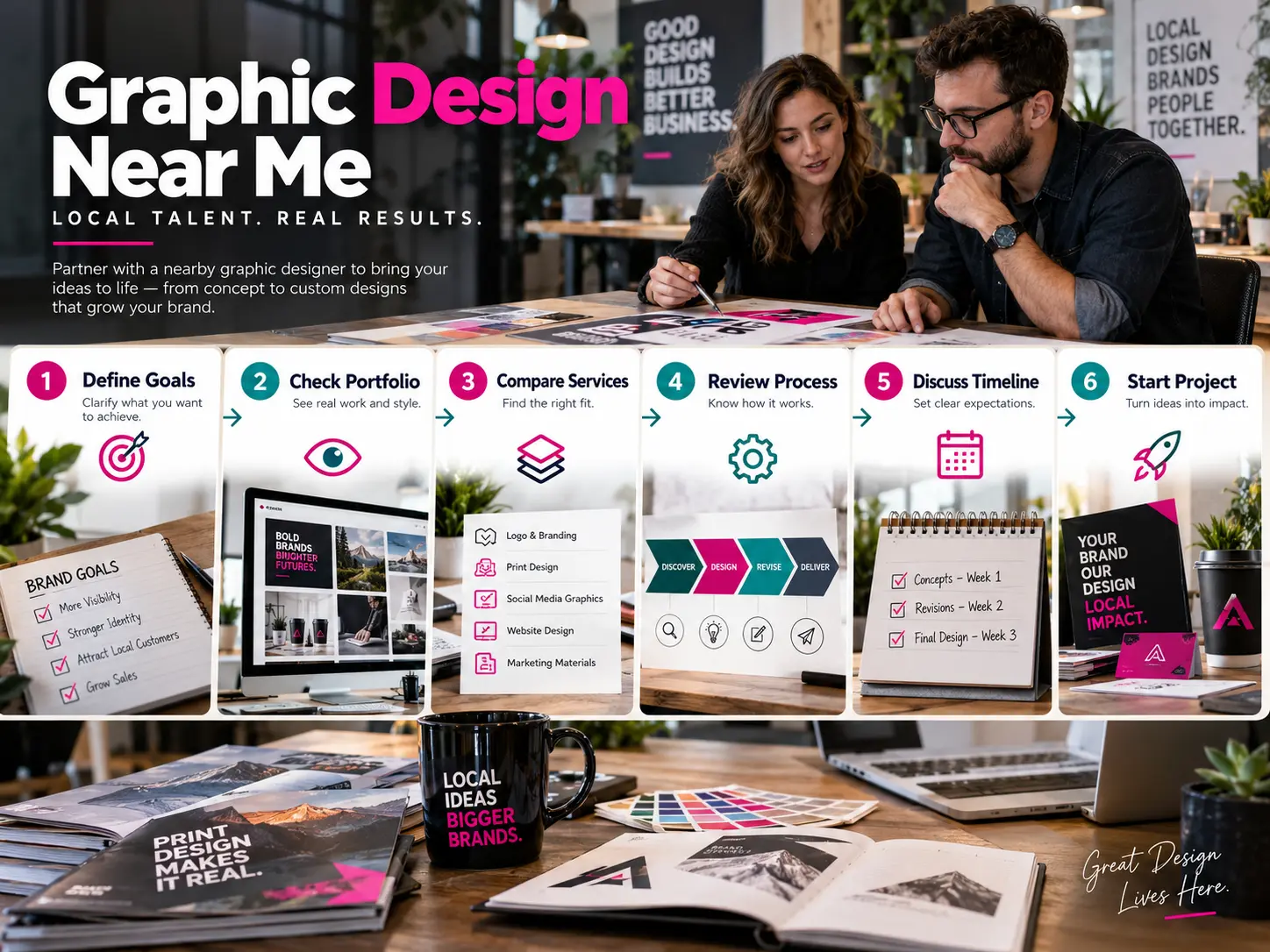
A professional process usually has several stages.
Discovery
The designer learns about the business, audience, goals, competitors, required formats, deadlines, and constraints.
Direction
For larger projects, the designer may establish a visual direction, references, mood, or initial concepts before producing every asset.
Design
The first complete concepts are developed around the approved direction.
Review
The client gives consolidated feedback. Strong feedback explains the business reason behind a requested change rather than simply saying “make it pop.”
Revision
The designer refines the work while protecting hierarchy, readability, and consistency.
Final Production
Files are prepared in the formats required for web, print, social media, vendors, or internal use.
What to Include in a Graphic Design Brief
A clear brief saves time and reduces revision rounds.
Include:
- Business name
- Project type
- Objective
- Target audience
- Main message
- Required text
- Brand colors and fonts
- Existing logo files
- Examples of styles you like
- Examples you do not like
- Final dimensions
- Print specifications if applicable
- Required file formats
- Deadline
- Where the design will be used
If the design is for printing, provide the printer’s template or specifications at the beginning, not after the design is finished.
Understand File Formats Before the Project Ends
Different uses require different final files.
PNG
Useful for digital graphics and transparent backgrounds.
JPG
Common for photographs and web graphics without transparency.
Common for print-ready files, presentations, and document sharing.
SVG
Useful for scalable vector graphics on websites and some digital applications.
AI, EPS, or Other Editable Source Formats
Often needed when future professional edits or specialized production are expected.
Ask what is included in the project. Do not assume editable source files are automatically part of every design agreement.
If the Design Will Be Printed, Ask Production Questions Early
Print design is not simply a digital graphic sent to a printer.
Depending on the job, the designer may need to consider:
- Bleed
- Trim size
- Safe margins
- Color mode
- Image resolution
- Folds
- Binding
- Spot colors
- Die lines
- Finishing
- Paper or substrate
A design can look perfect on screen and still fail in production if the setup is wrong.
How Much Does Graphic Design Cost?
There is no single fair price for “graphic design” because the scope can range from a simple social post to a complete identity system.
Price is usually affected by:
- Project complexity
- Number of concepts
- Number of pages or assets
- Research required
- Illustration needs
- Photo editing
- Revision rounds
- Turnaround time
- Source file requirements
- Print production complexity
- Designer experience
Compare scope, not only the final number. A cheaper quote can become expensive if it excludes revisions, source files, production setup, or the additional formats you need.
Red Flags When Choosing a Graphic Designer
Be cautious if a provider:
- Has no relevant portfolio
- Cannot explain the process
- Uses copyrighted work without permission
- Promises unlimited concepts instantly
- Cannot provide correct print specifications
- Does not clarify file ownership or licensing
- Communicates inconsistently
- Copies competitor designs too closely
- Uses logo templates while describing the result as fully original
- Cannot explain how revisions are handled
Good design work needs both creativity and project discipline.
Questions to Ask Before Hiring
Use these questions during an initial conversation:
- Have you designed this type of asset before?
- What information do you need from me?
- How many initial directions are included?
- How are revisions handled?
- What is the estimated delivery process?
- What file formats will I receive?
- Are editable source files included?
- Who owns the final design?
- Are any third-party fonts, images, or assets licensed separately?
- Can you prepare files for my printer or vendor?
- How do you keep multiple assets consistent with the brand?
Do You Need a Graphic Designer or a Branding Agency?
Choose a graphic designer when the visual identity is already established and you need a specific asset created correctly.
Consider a branding team when you need to define or redesign:
- Logo
- Brand colors
- Typography
- Visual system
- Brand guidelines
- Multiple marketing materials
- Website look and feel
- Consistent campaign direction
Our branding services are designed for businesses that need consistency across several touchpoints, while its logo design service focuses on building a recognizable core identity.
FAQs
Q1. How do I find good graphic design near me?
Start with local search results, portfolios, reviews, business directories, referrals, and nearby agencies. Then compare providers by relevant experience, process, communication, file delivery, and ability to understand your brand rather than choosing only by distance.
Q2. Is it better to hire a local graphic designer?
It depends on the project. Local designers are especially useful for site visits, local vendor coordination, physical proofs, and installations. Remote teams can work very effectively for branding, digital design, websites, presentations, and print-ready files.
Q3. What should I send a graphic designer?
Send the project brief, final text, logo files, brand guidelines, preferred dimensions, examples, print specifications, deadline, and any images or assets that must be used.
Q4. What file formats should a designer provide?
The answer depends on use. Common outputs include PNG, JPG, PDF, SVG, and editable source files. Confirm requirements before the project begins.
Q5. How do I know if a designer is professional?
Look for relevant portfolio work, a clear process, consistent communication, realistic timelines, proper file preparation, transparent revision terms, and an understanding of licensing and production requirements.
Choose for Fit, Not Just Distance
A search for graphic design near me is a good starting point, but proximity should not be the only decision factor. The designer needs to understand the business, communicate clearly, solve the actual visual problem, and deliver files that work in the real world.
Review portfolios carefully, define the scope, clarify ownership and formats, and choose a partner whose process matches the importance of the project. The right designer may be across town or working remotely; what matters most is whether the work strengthens your brand and performs correctly wherever it is used.
Tagged with :